A market research study projects that the global SEO market...
Read More


How B2B Podcast Marketing Builds Authority and Drives Pipeline
Podcasting has become an increasingly important channel for brands looking...
Read More

How B2B Video Marketing Improves Brand Trust and Sales Conversions
Think about the last time you considered buying a B2B...
Read More
You Don’t Know You are Scaling Until the Questions Change
A founder asks, ‘Can we do it?’ A scaling company...
Read More
Schema Markup for SEO: Essential Structured Data Every B2B Website Needs
According to the July 2026 Schema.org usage dataset, 5,545 Schema.org...
Read More
How a Sportsman’s Mindset Shapes Business Growth
What can building a business learn from building an athlete?...
Read More
How to Build a LinkedIn Marketing Strategy That Generates High-Quality B2B Leads
A strong LinkedIn marketing strategy is necessary if you want...
Read More
The Ultimate List of AI Search Optimization Tools for 2026
Your brand’s reputation is now stored in a new algorithm...
Read More
The Shop Floor Does Not Build Buyer Preference
A manufacturing company can have excellent products, strong engineering capabilities,...
Read More
Topical Authority in 2026: Creating Content AI Models Trust
Over 96.55% of all pages in our index receive zero...
Read More
A strong LinkedIn marketing strategy is necessary if you want to stand out on the world’s largest professional network. There are about 67.1 million organizations with a LinkedIn page. The platform has grown far beyond a simple job board; it’s now an active space for B2B marketing, brand building, and lead generation.
As more businesses and entrepreneurs compete for attention, having a clear, effective marketing strategy can be the difference between being ignored and building meaningful connections that boost growth. This guide will walk you through using LinkedIn and a marketing strategy to elevate your results and convert attention into action.
What Is a LinkedIn Marketing Strategy?
The process of using LinkedIn to increase brand recognition, produce leads, cultivate connections, and establish thought leadership with a professional audience is known as LinkedIn marketing. It includes both paid promotion (such as sponsored content and thought leader ads) and organic activity (such as company page posts and employee content).
The context is what makes LinkedIn unique. People are prepared to learn, network, and make business decisions when they arrive with a professional attitude. Because of this, it differs greatly from platforms designed for entertainment or keeping in touch with friends.
Additionally, business is conducted there. LinkedIn’s strengths in lead generation and relationship-building make it the best platform for business-to-business marketing. This gives marketers direct access to decision-makers in an environment that welcomes expert content.
How to build a LinkedIn marketing strategy
A smart LinkedIn marketing strategy starts with clear goals, a deep understanding of your audience, a strong presence, valuable content, and ongoing optimization.
How do you set specific goals for LinkedIn marketing?
Take a moment to think about the bigger (marketing) picture. What do you want this platform to do for your brand? How will LinkedIn fit into your overall marketing strategy? What specific goals do you want to reach?
For B2C companies, LinkedIn might serve primarily as a recruiting platform. Only you and your team can decide what makes the most sense for you.
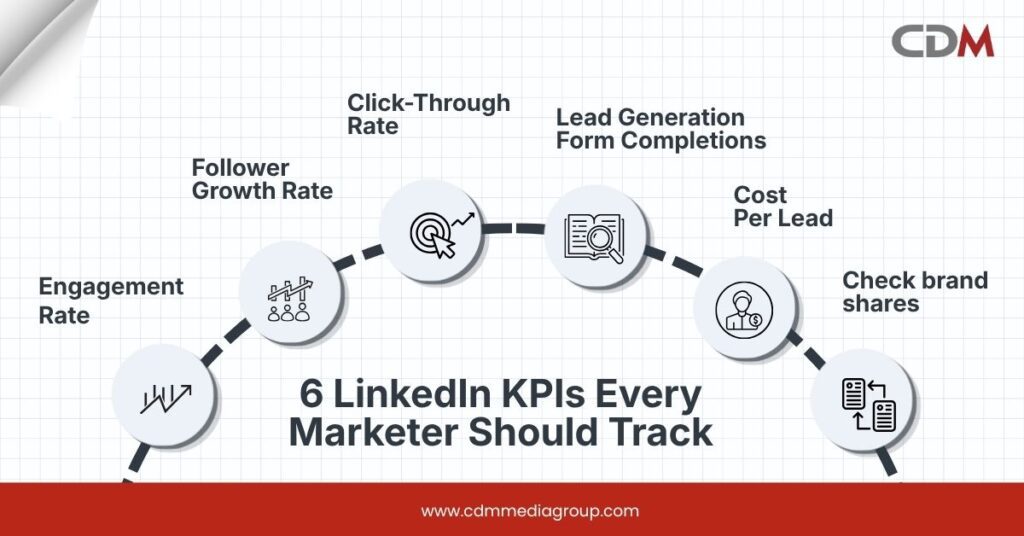
Once you know your goals, translate them into specific KPIs. Common LinkedIn KPIs include:
- Engagement rate: How actively your audience interacts with your content.
- Follower growth rate: How quickly your audience is expanding.
- Click-through rate: How often people click your links or CTAs.
- Lead gen form completions: How many leads do your campaigns capture?
- Cost per lead: How efficiently your paid spend converts.
- Share of voice: How visible your brand is compared to competitors.
Don’t know where to start? Check out our blog post on setting goals for social media marketing. Once you set your goals, craft specific LinkedIn KPIs to keep things on track.
Key LinkedIn marketing KPIs to track are engagement rate, follower growth, click-through rate, lead gen completions, cost per lead, and share of voice
How do you research your LinkedIn target audience?
LinkedIn’s demographics look a little different from what you’ll find on other platforms. Users tend to be older and have a higher income.
But that’s just a starting point. What really matters is understanding your audience and what they actually want from you on LinkedIn.
LinkedIn analytics are a good way to find the demographics specific to your audience. Within your Visitor and Follower dashboards, you can see what industries your followers are in, their job functions, seniority, location, and company size.
LinkedIn research shows that 38% of sellers who use AI to research leads and companies save over 1.5 hours per week.
How do you optimize your LinkedIn company page and executive profiles?
LinkedIn data shows that complete pages get 30% more weekly views.
No matter what goals you’re working towards, make sure your LinkedIn company page is fully filled out with all the tabs and sections available to you. A complete, active page is one of the simplest ways to grow your brand on LinkedIn.
For larger organizations, Showcase Pages can help keep your content marketing focused on the right audience. Try setting them up for different initiatives or programs within your company.
And whatever you do, don’t let your main page sit untouched for months at a time. LinkedIn recommends updating your cover image at least twice a year, which is an easy cue to give your page a quick refresh.
Your executive team’s profiles deserve the same love. We’ll dig into the why a bit later, but for now, make sure each exec’s profile feels complete: strong profile and background images, a clear headline, and a summary that actually sounds like a human.
How do you develop a LinkedIn content strategy?
LinkedIn is, at its core, a place for connection. People show up there to learn, share ideas, and build relationships, so your content should feel like part of that ecosystem.
A good rule of thumb is to keep a healthy content mix. The 4-1-1 rule is a simple framework: for every 6 pieces of content, share 4 pieces of relevant content from others, 1 soft promotional post, and 1 hard promotional post. Just be sure to add your own perspective to everything you share.
It also helps to vary your formats. Here are the LinkedIn content types that perform well in 2026:
- Short-form video: The fastest-growing and highest-engagement format on the platform.
- Carousels and document posts: Swipeable, value-packed content that holds attention.
- Text-only posts: Quick, off-the-cuff updates that spark conversation.
- LinkedIn newsletters: A way to build a subscribed audience around your expertise.
- LinkedIn articles: Long-form content for deeper thought leadership.
- Polls: A low-effort way to drive engagement and gather audience insights.
Key Benefits of a LinkedIn Marketing Strategy
LinkedIn’s business environment offers strategic marketing advantages over other channels. It:
Gives Access to a Highly Targeted Audience
You’re more likely to reach company decision-makers on LinkedIn than on Facebook or Instagram. The platform doesn’t just help you look for professional users.
Enhances Brand Credibility and Authority
LinkedIn is where people primarily go to learn. Research is a normal part of the B2B buying cycle, and business leaders on the platform look for new insights from fellow leaders and professionals when making business decisions.
Facilitates Networking
As the largest professional network, there’s no better place to build connections with prospective customers, partners, and industry influencers than LinkedIn.
Is Effective in Generating B2B Leads
LinkedIn is a great platform for B2B lead generation because it helps you to reach potential customers. According to SearchLab’s LinkedIn statistics, posts between 1,200 and 1,600 characters usually perform well in terms of engagement. A longer thought-leadership posts (2,500+ characters) can get 42% more saves and shares.

Final Thought
Looking to transform your LinkedIn presence into a lead-generating powerhouse? CDM Media Group helps businesses create data-driven LinkedIn marketing strategies that increase brand visibility, strengthen thought leadership, and drive measurable business results. Whether you want to grow your audience, generate qualified B2B leads, or maximize your marketing ROI, our experts are here to help.
Get in touch with CDM Media Group today!
FAQs
1. Why is a LinkedIn marketing strategy important?
A LinkedIn marketing strategy helps businesses increase brand visibility, generate quality leads, and build professional credibility.
2. What type of content performs best on LinkedIn?
Short-form videos, carousels, thought leadership posts, newsletters, and polls typically deliver the highest engagement.
3. How often should I post on LinkedIn?
Posting consistently 3–5 times per week helps maintain visibility and audience engagement.
4. What are the key LinkedIn marketing KPIs?
Important KPIs include engagement rate, follower growth, click-through rate (CTR), lead generation, cost per lead (CPL), and share of voice.
5. Is LinkedIn suitable for B2B marketing?
Yes, LinkedIn is one of the most effective platforms for B2B marketing because it connects businesses directly with decision-makers and industry professionals.