You’ve got a Slack workspace with 847 members. Your Discord...
Read More



International SEO Strategy: Common Mistakes SaaS Companies Should Avoid
A market research study projects that the global SEO market...
Read More

How to Create Sales Enablement Content for Every Stage of the B2B Buyer’s Journey
According to Gartner’s 2026 sales survey, 67% of B2B buyers...
Read More
How B2B Podcast Marketing Builds Authority and Drives Pipeline
Podcasting has become an increasingly important channel for brands looking...
Read More
How B2B Video Marketing Improves Brand Trust and Sales Conversions
Think about the last time you considered buying a B2B...
Read More
You Don’t Know You are Scaling Until the Questions Change
A founder asks, ‘Can we do it?’ A scaling company...
Read More
Schema Markup for SEO: Essential Structured Data Every B2B Website Needs
According to the July 2026 Schema.org usage dataset, 5,545 Schema.org...
Read More
How a Sportsman’s Mindset Shapes Business Growth
What can building a business learn from building an athlete?...
Read More
How to Build a LinkedIn Marketing Strategy That Generates High-Quality B2B Leads
A strong LinkedIn marketing strategy is necessary if you want...
Read More
The Ultimate List of AI Search Optimization Tools for 2026
Your brand’s reputation is now stored in a new algorithm...
Read More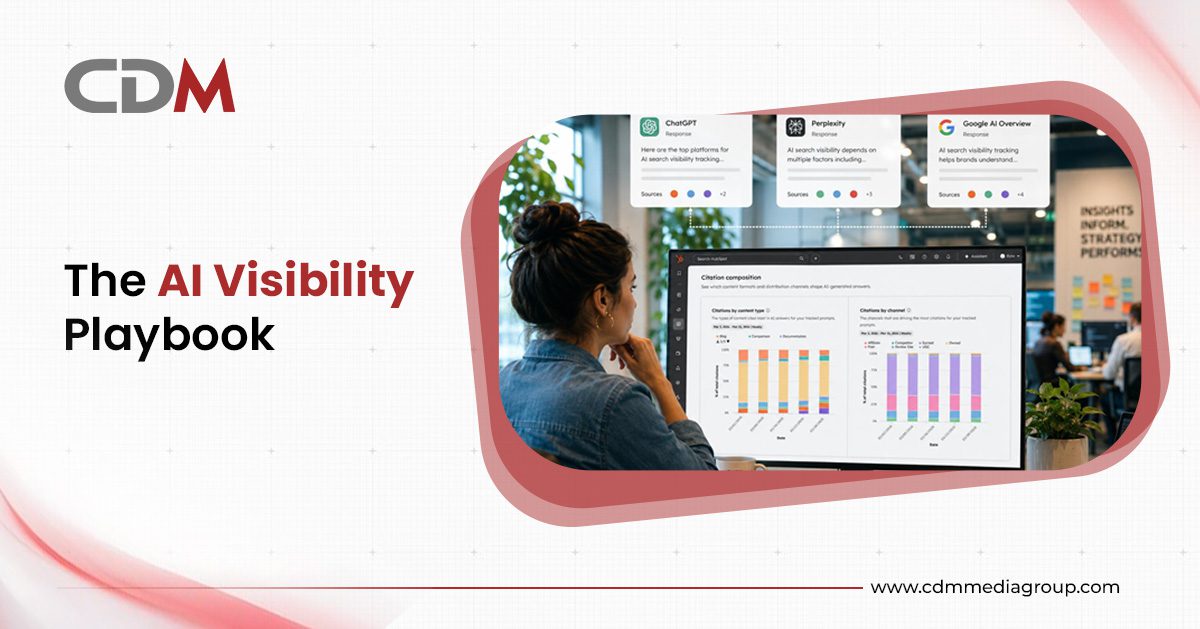
The evolution of search is here. Users are shifting away from scrolling through traditional ‘blue links’ toward instant, synthesized answers from platforms such as ChatGPT, Google AI Overviews, and Perplexity. For brands, this means the playbook for visibility and authority has officially changed.
Traditional SEO metrics such as keyword rankings and CTR are no longer enough. Success now depends on AI search visibility and how often your brand is cited, trusted, and recommended by conversational agents. To win, businesses must pivot from simply ranking on a page to becoming the definitive, context-rich source that AI platforms choose to summarize.
What is AI search visibility?
AI search visibility refers to how often and effectively your brand, products, or content appear in AI search and large language models (LLMs). This includes search experiences such as Google AI Overviews, ChatGPT, Perplexity, and other answer engines that synthesize information and provide direct answers to a user’s question, often citing their sources.
These AI models process billions of data points, drawing from brand websites, academic papers, and other online content to generate comprehensive, conversational responses tailored to a user’s specific query.
When your content or brand is mentioned or cited by AI, that impacts your AI search optimization. This represents a significant shift from traditional search engine results pages (SERPs), where the primary goal was to rank highly on a list of links. Now, the emphasis is on being the definitive, authoritative source that an AI can retrieve and reference.
How to measure and improve AI search visibility
The biggest pain point for marketers right now is tracking. You can’t use standard Google Search Console data to see if Perplexity recommended you. Introduce the new metrics that actually matter:
| Metric | What It Measures | How to Track It |
| Share of Voice (SoV) / Citation Frequency | How often your brand is mentioned or cited across a pool of 50–100 core industry prompts. | Manual prompt auditing or specialized GEO tracking tools. |
| Context Accuracy / Perception Drift | Whether the AI describes your brand, features, and sentiment correctly, or if its understanding is flawed. | Analyzing the tone and descriptive adjectives the LLM uses in its summaries. |
| Source Diversity | The mix of where AI pulls your data from (e.g., your own site vs. a Reddit thread or a niche industry publication). | Checking the link sources in AI citations. |
AI citation logic has completely decoupled from Google rankings. Aherfs found a moderate positive correlation between Google rankings and citations in AI Overviews, with 76% of cited URLs coming from pages in the top 10.
How Your Content Wins in AI Search Visibility
AI models favor authoritative, structured, and helpful content that clearly answers questions. Long introductions that delay the delivery of useful information are often ignored.
Write with genuine intent to help readers. Break complex topics into clear sections. Provide concrete examples instead of vague advice. If discussing email marketing segmentation, explain exactly how to segment, what criteria to use, and which tools support the process.
Depth matters more than volume for AI search optimization. One comprehensive guide often outperforms many shallow articles. Focus on covering fewer topics with real expertise rather than spreading effort thinly.
Content structure also plays a critical role in generative engine optimization (GEO). Clear headings, lists, tables, and logical organization help both humans and AI systems understand your content.
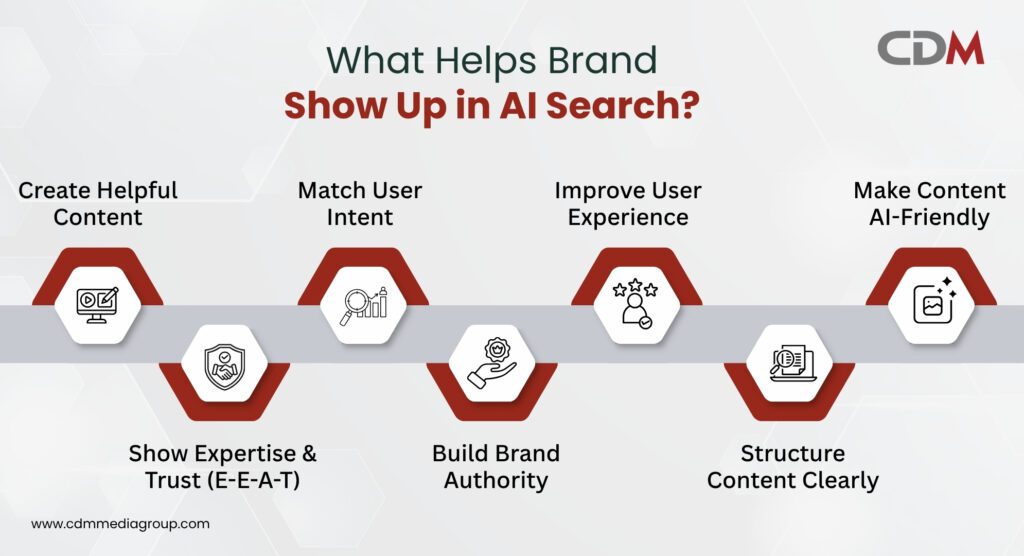
What actually controls your visibility in AI tools?
Here are some of the key factors in how to measure and improve AI search visibility:
- Content quality and authority: AI models that source from real-time search data/indexes favor high-quality, comprehensive, and factually accurate content. The better the content, the more likely it is to be mentioned or cited.
- Authorship and expertise: AI models, like AI search rankings, look for signals of Experience, Expertise, Authoritativeness, and Trustworthiness (E-E-A-T). Brands with a strong reputation for expertise in their field are more likely to be cited by AI.
- User intent and content relevance: AI models are designed to understand complex queries on a topical level and provide highly relevant responses. That means your content should anticipate user questions, offer clear, concise solutions, and improve overall topical authority. An element of your site’s topical and domain authority is how well your site holistically covers a topic, understands user needs, and provides content that answers their questions.
- Brand mentions and citations: Just as backlinks signal authority in traditional SEO, brand mentions and citations from other sources are critical for AI search rankings. When reputable sources mention your brand or link to your content, it’s essentially a vote of confidence in your brand that AI models recognize.
- User experience: While not a direct factor for AI visibility, a strong user experience (UX) can indirectly impact it. Just like with SEO, a positive UX can contribute to your overall site authority, which AI models may consider when evaluating sources.
- Content structure: AI models can more easily parse and understand well-structured content. This includes using clear headings and subheadings, bulleted or numbered lists, tables, and definitional content. Well-structured content also provides a better UX, helping to boost your authority amongst your audience.
- LLM accessibility: For LLMs to use your content effectively, it must be easily accessible and understandable by machines. This means ensuring your website’s technical foundation is solid and taking steps like leveraging Schema markup.

Final Thought
AI search is shifting brand visibility from click competition to becoming a trusted, cited source. Success requires authoritative, structured content that directly addresses user intent in AI search rankings. Early investment in AI visibility secures a competitive edge by improving discoverability across answer engines.
CDM Media Group facilitates this transition through specialized optimization strategies that help to improve AI search visibility and ensure your business remains a reputable source in this new digital landscape.
FAQs
1. What is AI search visibility?
AI search visibility is how often your brand appears, is cited, or recommended in AI-generated answers from platforms like ChatGPT, Perplexity, and Google AI Overviews.
2. How can I measure AI search visibility?
Track metrics such as citation frequency, share of voice, source diversity, and brand perception across AI-generated responses.
3. Does ranking #1 on Google guarantee AI citations?
No, while strong rankings help, AI platforms prioritize authority, relevance, and content quality when selecting sources.
4. What type of content performs best in AI search?
Well-structured, authoritative, and intent-focused content that directly answers user questions tends to earn more AI citations.
5. How can I improve my brand’s visibility in AI search results?
Create expert-led content, strengthen brand authority, use clear content structures, and ensure your website is accessible to AI crawlers and LLMs.