You’ve got a Slack workspace with 847 members. Your Discord...
Read More


International SEO Strategy: Common Mistakes SaaS Companies Should Avoid
A market research study projects that the global SEO market...
Read More

How to Create Sales Enablement Content for Every Stage of the B2B Buyer’s Journey
According to Gartner’s 2026 sales survey, 67% of B2B buyers...
Read More
How B2B Podcast Marketing Builds Authority and Drives Pipeline
Podcasting has become an increasingly important channel for brands looking...
Read More
How B2B Video Marketing Improves Brand Trust and Sales Conversions
Think about the last time you considered buying a B2B...
Read More
You Don’t Know You are Scaling Until the Questions Change
A founder asks, ‘Can we do it?’ A scaling company...
Read More
Schema Markup for SEO: Essential Structured Data Every B2B Website Needs
According to the July 2026 Schema.org usage dataset, 5,545 Schema.org...
Read More
How a Sportsman’s Mindset Shapes Business Growth
What can building a business learn from building an athlete?...
Read More
How to Build a LinkedIn Marketing Strategy That Generates High-Quality B2B Leads
A strong LinkedIn marketing strategy is necessary if you want...
Read More
The Ultimate List of AI Search Optimization Tools for 2026
Your brand’s reputation is now stored in a new algorithm...
Read More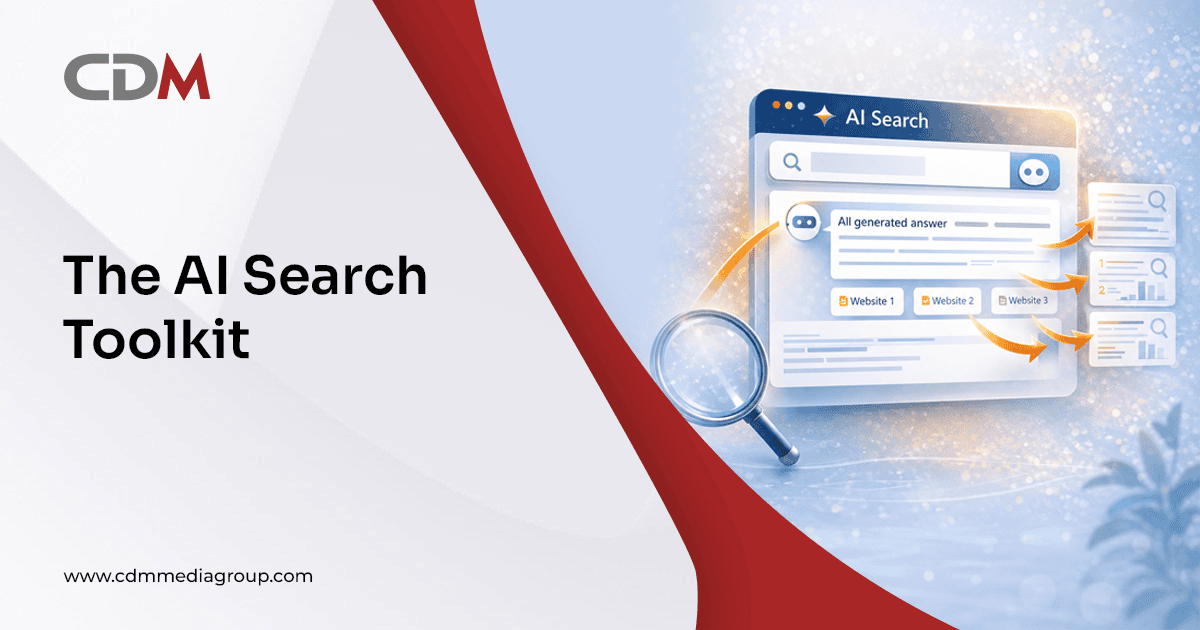
Your brand’s reputation is now stored in a new algorithm that uses AI search optimization tools such as SEMrush, Surfer SEO, Ahrefs, and AirOps, etc. One wrong fact, one competitor-friendly response, and trust, traffic, and sales can vanish overnight. With AI tool adoption growing and Google’s AI answers appearing in nearly half of searches, the risks and opportunities have never been higher.
AI search optimization tools now change whether your brand shows up inside AI tools or gets skipped in AI answers. That is the real problem. Your organic traffic can slide even while your classic rankings look fine in your old dashboards. This is where AI search optimization tools become crucial.
In this guide, you will learn about the best AI search optimization tools that help your content appear in those AI searches and not just in SERP results.
Why use AI search optimization tools?
Search behavior is changing rapidly. ChatGPT, Gemini, Perplexity, and Google AI Overviews are increasingly popular alternatives to traditional search, but they may not always display your website. They display names that they trust.
AI search optimization tools provide insight into where your brand fits in the new landscape. They tell you which prompts trigger your brand, which competitors are recommended instead, and which sources AI models use to generate answers. Without them, you’re essentially flying blind in a channel that is quietly reducing your organic traffic.
More practically, they turn that data into action by highlighting content gaps, weak authority signals, and missed citation opportunities, allowing you to address them before competitors.
If AI search is already changing your customer decisions, you must understand exactly where you stand.
Best AI search optimization tools for improving visibility
Semrush
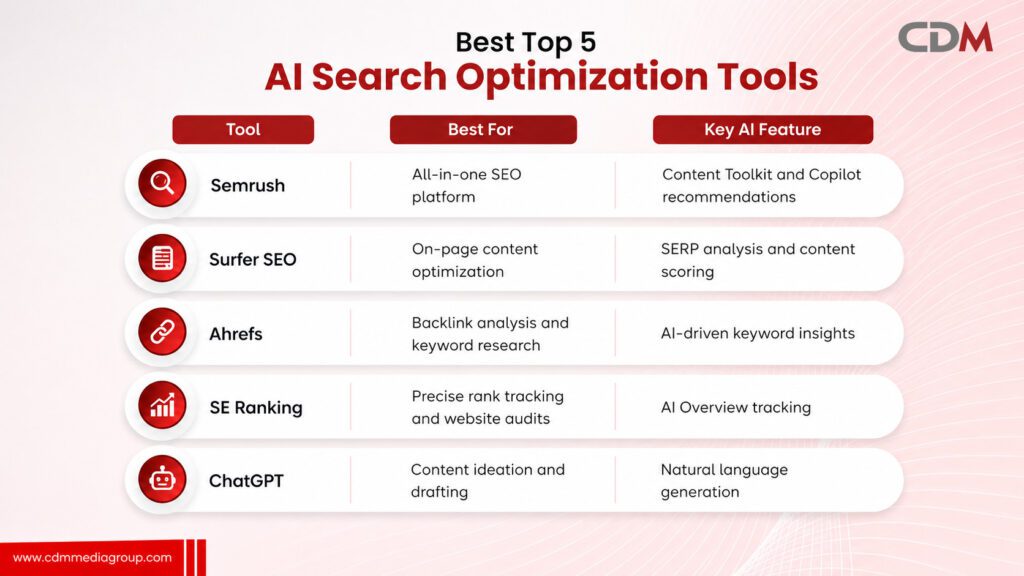
Semrush is an all-in-one SEO platform featuring AI SEO tools. Its Content Toolkit analyzes top-ranking pages for topic coverage, while Copilot provides personalized site recommendations. It is a comprehensive solution for keyword research, competitive analysis, technical audits, and content optimization.
AirOps
AirOps helps you design custom AI workflows rather than depending on fixed templates. You can pull in GPT-5.2, GPT-4.1, Claude, Gemini, and other models, then chain them together for programmatic SEO tasks. That flexibility turns it into more than just another SEO content optimization tool, making it a complete content system.
HubSpot AEO
HubSpot AEO helps brands understand how they appear across AI search platforms such as Claude, ChatGPT, Gemini, and Perplexity. Instead of focusing only on rankings, the platform tracks prompt-level visibility, brand mentions, competitor presence, and sentiment across AI search answers, making it a practical tool for teams adapting to generative search.
Surfer SEO
Surfer SEO specializes in on-page optimization by analyzing top-ranking pages for specific keywords. It provides a content score and actionable suggestions, such as target word counts and relevant terms, making it highly valuable for teams focused on refining existing content.
Ahrefs
Renowned for backlink analysis, Ahrefs now features AI-driven keyword research. These tools offer insights into search volume and ranking difficulty, helping SEO experts optimize content based on performance data. For professionals focused on link building and competitive analysis, Ahrefs remains a vital resource.
SE Ranking
SE Ranking offers enterprise-level features at a price point accessible to smaller teams. A major highlight is its AI Overview Tracker, which tracks brand presence in AI search results, a vital capability as search engines increasingly integrate AI.
Clearscope
Clearscope focuses on content optimization by grading drafts against top-ranking pages. Using semantic analysis to evaluate context rather than keyword density serves as a comprehensive final check for marketers.
Frase
Frase simplifies content research by aggregating top-ranking data, questions, and statistics into comprehensive briefs. It enables high-volume teams to maintain consistent research standards across multiple writers.
ChatGPT
ChatGPT is a versatile AI assistant useful for brainstorming, drafting, and rewriting SEO content. Lacking real-time search data, it is most effective when paired with specialized GEO tools.
Jasper
Jasper specializes in AI writing that adapts to your brand voice, ensuring content sounds authentic rather than generic. Integrating with Surfer SEO, it allows teams to optimize for search while keeping messaging consistent.
MarketMuse
MarketMuse focuses on building deep topical authority for your niche rather than on singular, isolated pages. It scans your complete site to spot coverage gaps, then suggests which themes to expand next. If you manage a big content library, it feels more like a strategy partner than another AI content optimization tool.
Search Atlas
Search Atlas caters to agencies by automating optimization through its OTTO SEO feature. It includes white-label reporting and streamlines the management of multiple SEO campaigns, reducing manual effort for client deliverables.
Writesonic
Writesonic quickly produces SEO articles, though human editing is necessary for quality and fact-checking. Teams often use it to generate initial drafts at scale, which editors then refine.
Why Your SEO Strategy is Only as Good as Your Toolkit
If you’ve already worked through the beginner guide, you know the fundamentals of search intent, AI content, structured data, and how Google’s AI Overviews are reshaping what it means to ‘rank.’ Good. That foundation matters. Now it’s time to get tactical.
You know most SEO professionals are still using yesterday’s tools for tomorrow’s search landscape. They’re running keyword reports the same way they did in 2019, writing content without checking AI intent signals, and wondering why their traffic is flat.
The right AI search optimization tools don’t just save you time. They fundamentally change what’s possible and what’s visible. From uncovering AI search trends to optimizing content for answer engines, modern GEO success depends on using tools that work for the future of search.
At CDM Media Group, we help brands stay ahead with AI SEO strategies, advanced search optimization tools, and data-backed content solutions built for today’s evolving digital landscape.
Contact Us Today!

FAQs
1. What are AI search optimization tools?
AI search optimization tools help brands improve visibility and citations in AI-generated answers from platforms like ChatGPT, Gemini, and Perplexity.
2. How are GEO tools different from traditional SEO tools?
GEO tools focus on AI-generated search results and brand mentions, while traditional SEO tools primarily track rankings and organic traffic.
3. Why is AI visibility important for brands in 2026?
As more users rely on AI assistants for answers, brand visibility in AI responses directly influences trust, traffic, and conversions.
4. Which AI search optimization tool is best for tracking brand mentions?
Tools like Wellows and AirOps specialize in monitoring brand citations, sentiment, and visibility across major AI platforms.
5. Can AI SEO tools improve rankings in Google AI Overviews?
Yes, AI SEO tools help identify content gaps, authority signals, and citation opportunities that can increase visibility in Google AI Overviews and other AI-driven search experiences.