You’ve got a Slack workspace with 847 members. Your Discord...
Read More



International SEO Strategy: Common Mistakes SaaS Companies Should Avoid
A market research study projects that the global SEO market...
Read More

How to Create Sales Enablement Content for Every Stage of the B2B Buyer’s Journey
According to Gartner’s 2026 sales survey, 67% of B2B buyers...
Read More
How B2B Podcast Marketing Builds Authority and Drives Pipeline
Podcasting has become an increasingly important channel for brands looking...
Read More
How B2B Video Marketing Improves Brand Trust and Sales Conversions
Think about the last time you considered buying a B2B...
Read More
You Don’t Know You are Scaling Until the Questions Change
A founder asks, ‘Can we do it?’ A scaling company...
Read More
Schema Markup for SEO: Essential Structured Data Every B2B Website Needs
According to the July 2026 Schema.org usage dataset, 5,545 Schema.org...
Read More
How a Sportsman’s Mindset Shapes Business Growth
What can building a business learn from building an athlete?...
Read More
How to Build a LinkedIn Marketing Strategy That Generates High-Quality B2B Leads
A strong LinkedIn marketing strategy is necessary if you want...
Read More
The Ultimate List of AI Search Optimization Tools for 2026
Your brand’s reputation is now stored in a new algorithm...
Read More
To understand the latest advancements in generative AI, imagine a courtroom.
Judges hear and decide cases based on their general understanding of the law. Sometimes a case, such as a malpractice suit or a labor dispute, requires special expertise, so judges send court clerks to a law library to find precedents and specific cases they can cite.
Like a good judge, large language models (LLMs) can respond to a wide variety of human queries. But to deliver authoritative answers grounded in specific court proceedings or similar cases, the model needs that information.
The court clerk of AI is a process called retrieval-augmented generation (RAG).
What is Retrieval-Augmented Generation?
It is the process of optimizing a large language model’s output by referring to an authoritative knowledge base outside of its training data before producing a response. Large Language Models (LLMs) are trained on massive amounts of data and use billions of parameters to produce unique results for tasks such as question answering, language translation, and sentence completion. RAG broadens the already powerful capabilities of LLMs to specific domains or an organization’s internal knowledge base, all without the need to retrain the model. It is a low-cost way to improve LLM output while keeping it relevant, accurate, and useful in a variety of contexts.
How does RAG work?
Step 1: The query is received. The user asks a question or submits a prompt.
Step 2: The RAG for AI searches the knowledge base. The system converts the query into a numerical representation (known as an embedding or vector) and searches an external knowledge base to find the most semantically relevant documents or data chunks.
Step 3: The relevant information is returned. The most relevant content is extracted from the knowledge base and fed into the language model as additional context.
Step 4: The prompt is augmented. The original user query is combined with the AI retrieval system’s content to create an enriched prompt.
Step 5: The LLM produces a response. The language model uses both its built-in knowledge and retrieved context to create an accurate, up-to-date response based on real data.
Step 6: The answer is returned to the user. In many systems, the response includes citations or source references that allow the user to verify the information.
Why AI Search Engines Depend on RAG
Modern AI search engines are designed to understand intent, context, and semantic meaning. Users no longer search solely with short keyword phrases.
Instead, they ask complete questions like:
- “What are the benefits of AI-driven search optimization?”
- “How does RAG improve AI search engine content discovery?”
- “What is the best way to optimize content for AI overviews?”
To answer these complex queries accurately, search engines need access to updated and trustworthy information sources. This is where AI retrieval systems become critical.
RAG enables AI search engines to:
- Retrieve fresh web content in real time
- Understand semantic relationships between topics
- Generate direct and conversational answers
- Cite authoritative information sources
- Improve answer accuracy and relevance
Without retrieval systems, generative AI models would rely only on static training data, which may be outdated or incomplete.
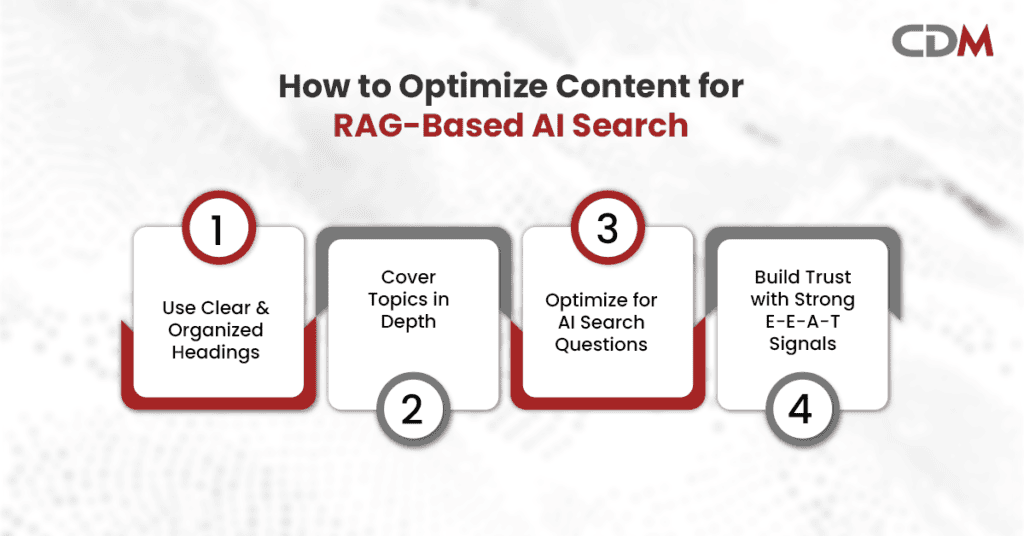
How to Optimize Content for RAG-Based AI Search
As AI search evolves, content optimization strategies must adapt as well. Here are several ways to improve discoverability in RAG-powered search systems.
Use Clear Content Structure
Well-structured content helps AI retrieval systems better understand information. Use:
- descriptive headings
- concise paragraphs
- bullet points
- FAQs
- logical topic flow
Clear structure improves semantic parsing and increases the likelihood of retrieval.
Focus on Topical Depth
AI search engines favor comprehensive content that fully addresses a topic. Instead of creating thin keyword-focused pages, develop in-depth resources that answer related questions and subtopics.
For example, a blog about retrieval-augmented generation should also discuss:
- AI retrieval systems
- semantic search
- generative AI
- AI Overviews
- content discovery
- contextual relevance
Optimize for Natural Language Queries
Users interact with AI search engines conversationally. Content should, therefore, include natural question-based phrases such as
- “What is Retrieval-Augmented Generation?”
- “How does RAG improve AI search engine content discovery?”
- “Why do AI search engines use retrieval systems?”
This helps align content with conversational search intent.
Strengthen E-E-A-T Signals
Experience, Expertise, Authoritativeness, and Trustworthiness (E-E-A-T) remain essential for AI discoverability.
To improve trust signals:
- cite credible data
- publish expert-driven insights
- maintain content accuracy
- Update outdated information
- create original and valuable content
Strong authority signals increase the likelihood of RAG for AI search
The four core components of a RAG system
Understanding how RAG works under the hood helps organizations implement and evaluate it more effectively. Every RAG system is built on four foundational components.
The knowledge base
The system draws on the knowledge base, an external data repository. It can store almost any type of content, such as internal documents, PDFs, help center articles, product specifications, meeting transcripts, CRM records, and more. Because a knowledge base is only as useful as it is up to date, it must be well-maintained and updated regularly to ensure the quality of RAG for AI search.
Embeddings and vector storage
Intelligent searching requires converting data into numerical vectors via embedding. These vectors are organized by semantic similarity in a vector database, enabling faster and more precise retrieval at query time.
Documents are first divided into chunks. Selecting an appropriate chunk size is vital: overly large segments generalize too much, while tiny ones lose context.
The retriever
The retriever is the component that searches the knowledge base when a query is received. It takes the user’s question as a vector and searches the knowledge base for the closest semantic matches, not just keyword matches, but conceptually similar content. This semantic search approach enables RAG for AI search to find relevant information even when the user’s phrasing does not exactly match the language of the source documents.
The generator
The generator is the large language model that produces the final response. With the augmented prompt in hand, the model produces an answer based on both its training and the specific context retrieved.

Final Thought
Retrieval-Augmented Generation (RAG) is redefining AI search by merging large language models with real-time, authoritative data. Brands that prioritize semantic relevance, topical authority, and trustworthy, natural-language content are more likely to appear in AI-generated answers.
CDM Media Group provides advanced content strategies, including AI search optimization and digital visibility solutions, to help businesses maintain authority and achieve growth in this evolving landscape.
FAQs:
1. What is Retrieval-Augmented Generation (RAG)?
RAG enhances AI responses by retrieving relevant information from external knowledge sources before generating an answer.
2. How does RAG improve AI search visibility?
RAG helps AI systems discover and reference authoritative content, increasing the likelihood that your content appears in AI-generated answers.
3. Why do AI search engines use RAG?
AI search engines use RAG to access current, accurate information beyond the model’s original training data.
4. How can content be optimized for RAG-based search?
Use clear structure, topical depth, natural language, and strong E-E-A-T signals to improve content retrieval.
5. What are the main components of a RAG system?
A RAG system consists of a knowledge base, embeddings/vector storage, a retriever, and a generator (LLM).