
Think about the last time you considered buying a B2B...
Read More




You Don’t Know You are Scaling Until the Questions Change
A founder asks, ‘Can we do it?’ A scaling company...
Read More

Schema Markup for SEO: Essential Structured Data Every B2B Website Needs
According to the July 2026 Schema.org usage dataset, 5,545 Schema.org...
Read More
How a Sportsman’s Mindset Shapes Business Growth
What can building a business learn from building an athlete?...
Read More
How to Build a LinkedIn Marketing Strategy That Generates High-Quality B2B Leads
A strong LinkedIn marketing strategy is necessary if you want...
Read More
The Ultimate List of AI Search Optimization Tools for 2026
Your brand’s reputation is now stored in a new algorithm...
Read More
The Shop Floor Does Not Build Buyer Preference
A manufacturing company can have excellent products, strong engineering capabilities,...
Read More
Topical Authority in 2026: Creating Content AI Models Trust
Over 96.55% of all pages in our index receive zero...
Read More
Winning in AI Search: How to Measure and Expand Your Visibility
The evolution of search is here. Users are shifting away...
Read More
How Retrieval-Augmented Generation Helps AI Search Engines Discover Content
To understand the latest advancements in generative AI, imagine a...
Read More
Copilot, Microsoft Start, and others handle billions of queries per month, integrating Bing deeply into how people search, shop, and explore the web.
For marketers and SEO professionals, this shift means visibility is no longer solely determined by rank. While there is no secret formula for being chosen by AI systems, success begins with content that is original, authoritative, structured, and semantically clear.
What is AI Search Optimization?
Generative engine optimization (GEO) optimizes digital content and online presence to increase visibility in AI-generated answers. Unlike traditional SEO, which seeks to rank webpages in search results, GEO focuses on generative engines that provide direct, summarized responses rather than lists of links.
Here’s how AI search engines differ from traditional search:
- Traditional SEO aims to rank content on a results page. Position and click-through rate serve as indicators of success.
- AI content optimization focuses on becoming the source that AI systems use to generate answers. Citation authority replaces backlinks, and the visibility score is more important than rank.
- It’s no longer about the click-through rate. It’s all about reference rates, which are how frequently AI models mention your brand or content.
- The stakes are higher. LLMs cite only 2-7 domains per response on average, compared to traditional search’s 10 blue links. Competition for AI visibility is fierce, but the benefits are significant.
How to optimize content for AI-powered search engines (Step-by-Step)
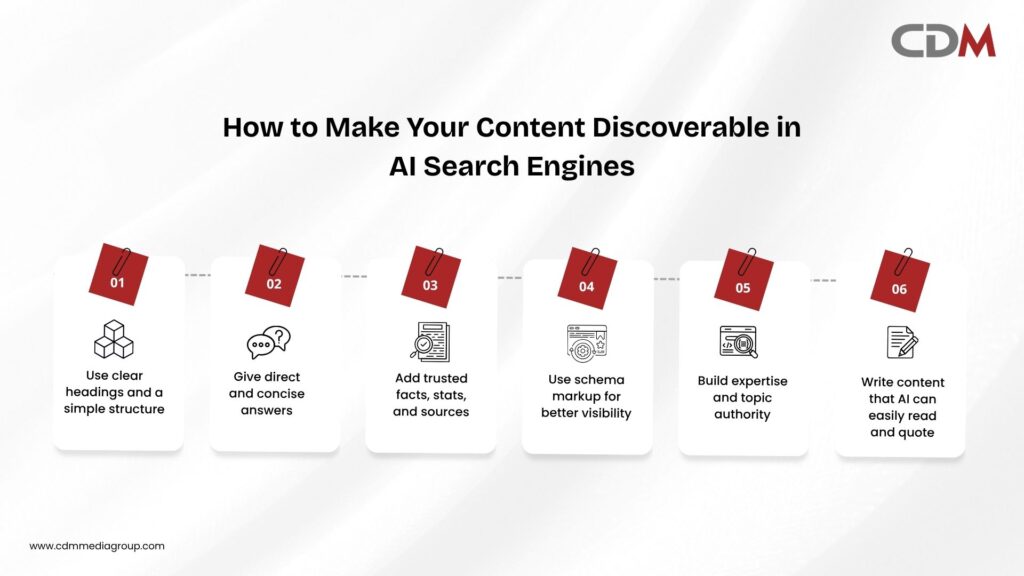
Ready to optimize your content for AI search engines? This framework brings together the latest research and proven best practices.
Step 1: Structure content with clear headings and logical flow
AI systems parse content by dividing it into segments and examining how concepts connect. Pages with clear H2/H3/bullet point structures receive 40% more citations from AI engines.
Because Q&A formats closely resemble how users ask questions, they work best for GEO. Structured content with distinct headings and lists performs almost as well for non-question queries. The worst prose is dense and unstructured.
Step 2: Answer questions directly and concisely
- Each section should begin with a direct response to the query posed in the header.
- Provide important information up front rather than building to a conclusion.
- To longer sections, add TL;DR summaries.
- Adopt a conversational tone that reflects the way people genuinely ask questions.
- To make your content more likely to be used and cited by AI systems, write like a human, not a brand.
Step 3: Include authoritative data, statistics, and citations
AI visibility is greatly increased by original research and reliable data. AI citations for pages with original data tables are 4.1 times higher.
According to research from Search Engine Land, adding statistical data improves citation performance by over 5.5% compared with individual optimization strategies.
Step 4: Use schema markup and structured data
AI citations are increased by 28% with proper article and FAQ schema. AI systems can better comprehend your content, its creator, and the relationships between its various components with the aid of schema markup.
AI search results, like Google AI Overview, are more likely to include pages with FAQ sections. AI can easily extract and surface questions and answers thanks to the FAQ schema.
Step 5: Build topical authority and E-E-A-T
Google’s E-E-A-T framework (experience, expertise, authoritativeness, and trustworthiness) remains relevant for GEO. Google’s AI systems evaluate credibility when deciding which sources to cite.
Show proof. Highlight credentials, cite data, provide links to credible sources, and publish content written by real experts. Ensure your certifications, awards, partnerships, and original research are easily accessible.
Step 6: Write in a format AI can easily parse and quote
Briefness and clarity improve your chances of being cited. AI engines will find it easier to extract and reuse your content if you provide concise, well-structured summaries.
Create content with a straightforward structure and natural language to make it AI-ready. Both AI systems and human readers benefit from headings, bullet points, and Q&A formats.
What AI Content Discoverability Signals Boost Visibility in AI Search?
AI search engines consider a variety of content signals when determining source credibility and relevance. Primary indicators include semantic relevance to the query, content depth and comprehensiveness, and the presence of supporting evidence, such as citations and data.
Freshness indicators significantly influence how AI search engines select sources, especially for rapidly evolving topics such as technology and current events. Content with recent publication dates, regular updates, and timely information is typically given higher priority in AI-generated responses.
Author expertise signals, such as author bios, credentials, and topical authority, significantly impact source selection. Google’s developer documentation emphasizes the importance of demonstrating expertise in content ranking, which includes AI search engines.
According to Google, articles with distinct section breaks, informative headings, and a scannable text structure outperform others in terms of AI citation rates. Tables, lists, and other structured components facilitate AI systems’ effective extraction of pertinent data.
External validation in the form of backlinks, social shares, and mentions from authoritative sources provides trust signals that AI systems use in their selection algorithms.

Conclusion
Content optimization is more crucial than ever as AI search reshapes digital visibility. Brands need to produce content that is organized, credible, comprehensible, and optimized for entity-based discovery in order to thrive in AI-driven search experiences. Businesses can increase their chances of being cited and recommended by AI systems by combining GEO, AEO, and SEO strategies with strong E-E-A-T signals, schema markup, and clear formatting. Brands that prioritize high-quality, AI-ready content will have a greater competitive advantage in online visibility as AI search continues to develop.
Connect with our team today to discuss how to position your brand visibility as the authoritative choice across ChatGPT, Perplexity, and emerging AI platforms.
FAQs
1. What is AI Search Optimization?
AI Search Optimization is the process of improving the visibility of AI-generated content and search experiences.
2. How is AI search optimization different from traditional SEO?
Traditional SEO focuses on rankings, while AI search optimization focuses on being cited and referenced by AI systems.
3. Why is structured content important for AI search?
Clear headings, lists, and logical formatting help AI engines better understand, extract, and cite your content.
4. Does schema markup help with AI visibility?
Yes, schema markup provides context that helps AI systems interpret and surface your content accurately.
5. What factors increase the chances of being cited by AI search engines?
High-quality content, authoritative sources, original data, strong E-E-A-T signals, and clear content structure all improve AI citation potential