
You’ve got a Slack workspace with 847 members. Your Discord...
Read More



International SEO Strategy: Common Mistakes SaaS Companies Should Avoid
A market research study projects that the global SEO market...
Read More

How to Create Sales Enablement Content for Every Stage of the B2B Buyer’s Journey
According to Gartner’s 2026 sales survey, 67% of B2B buyers...
Read More
How B2B Podcast Marketing Builds Authority and Drives Pipeline
Podcasting has become an increasingly important channel for brands looking...
Read More
How B2B Video Marketing Improves Brand Trust and Sales Conversions
Think about the last time you considered buying a B2B...
Read More
You Don’t Know You are Scaling Until the Questions Change
A founder asks, ‘Can we do it?’ A scaling company...
Read More
Schema Markup for SEO: Essential Structured Data Every B2B Website Needs
According to the July 2026 Schema.org usage dataset, 5,545 Schema.org...
Read More
How a Sportsman’s Mindset Shapes Business Growth
What can building a business learn from building an athlete?...
Read More
How to Build a LinkedIn Marketing Strategy That Generates High-Quality B2B Leads
A strong LinkedIn marketing strategy is necessary if you want...
Read More
The Ultimate List of AI Search Optimization Tools for 2026
Your brand’s reputation is now stored in a new algorithm...
Read More
The world of search is being rewritten. AI tools such as ChatGPT, Claude, and Google AI Overviews are transforming how people find information, often delivering answers with a single click.
This change is redefining SEO in 2026. You know, traditional SEO metrics like rankings and click-through rates are losing relevance, replaced by AI-first KPIs focused on visibility, credibility, and E-E-A-T (experience, expertise, authoritativeness, and trustworthiness) within AI-generated responses.
Today, SEO isn’t just about optimization; it’s about being understood by AI. Content must be structured, fast, trustworthy, and informative to earn a place in AI-driven answers.
As a result, the content ROI framework is evolving. Success is no longer measured by traffic alone but by three different stages, such as visibility (are you seen?), performance (are you answer-worthy?), and impact (are you driving results?).
The Growth of the Zero-Click Shift in 2026
Speaking of zero-click, around 93% of AI search sessions end without a website click, and AI Overviews reduce clicks to the top-ranking page by 58%, making answer visibility more important than traditional rankings. Research shows that for all-in-one triggered results, the median zero-click rate reached 80%, averaging around 83%. Traditional queries without AI overviews still hovered near 60%. Chartbeat data from March 2026 shows that publishers with 1,000 to 10,000 daily pageviews lost 60% of search referral traffic over two years. Medium publishers lost 47%. Large publishers lost 22%. The pattern is clear: the smaller you are, the harder you hit.
According to Gartner research, traditional search engine traffic will decline 25% by 2026 as AI assistants handle more queries directly. However, most dashboards overlook this crucial nuance: AI engines do not fail to cite content. It is working in a different place than your analytics can see.
Why Traditional SEO Metrics Don’t Work for Generative Search Optimization
It may look like a beneficial idea to transfer your SEO metrics to generative search optimization, but we’re here to set the record straight. No, your SEO metrics aren’t enough to show your successes or failures.
In generative search optimization, the goal isn’t necessarily to drive instant traffic or direct conversions. Instead, it’s about brand discovery and presence within AI-generated responses.
Why should you, as a brand, care? Because users frequently don’t go beyond the initial AI-generated answer. There’s no need to click a link, scroll through pages, or open multiple tabs. The AI delivers the entire response in one go. And yet, this interaction can significantly influence user behavior.
For instance, if ChatGPT lists your brand as a top tool in your industry, that mention may not immediately drive traffic. Instead, it serves as a brand awareness play, increasing the likelihood that users will later search for your brand, visit your site, or convert through another channel.
Since such activity is more difficult to measure, SEOs have been asking whether they can just use traditional SEO metrics like rankings, impressions, and click-through rates for a clear map of performance. The answer is two-fold.
Traditional SEO is largely deterministic, relying on predictable, rule-based systems where specific inputs such as keywords, backlinks, and technical optimizations directly influence ranking.
Generative search optimization (GEO) is probabilistic. Ask Claude the same question five times, and you might get five slightly different answers. This is because the AI isn’t pulling from a fixed index; it generates responses based on patterns in its training data and retrieves information from the web in real time.
What is content marketing ROI in AI-generated answers?
The content ROI framework is a key metric that helps you understand the financial impact of your content efforts. It compares the revenue generated from your content marketing activities against the total costs of producing and distributing that content. This essentially calculates your return on investment, showing if your content is generating actual business value or simply consuming resources.
According to the Content Marketing Institute (CMI), 42% of B2B marketers say they are challenged to maintain consistency in measuring content marketing ROI and require a better way to track the performance of content marketing strategies, both across their B2B companies as a whole and for individual content pieces.
How is content ROI measured in AI search?
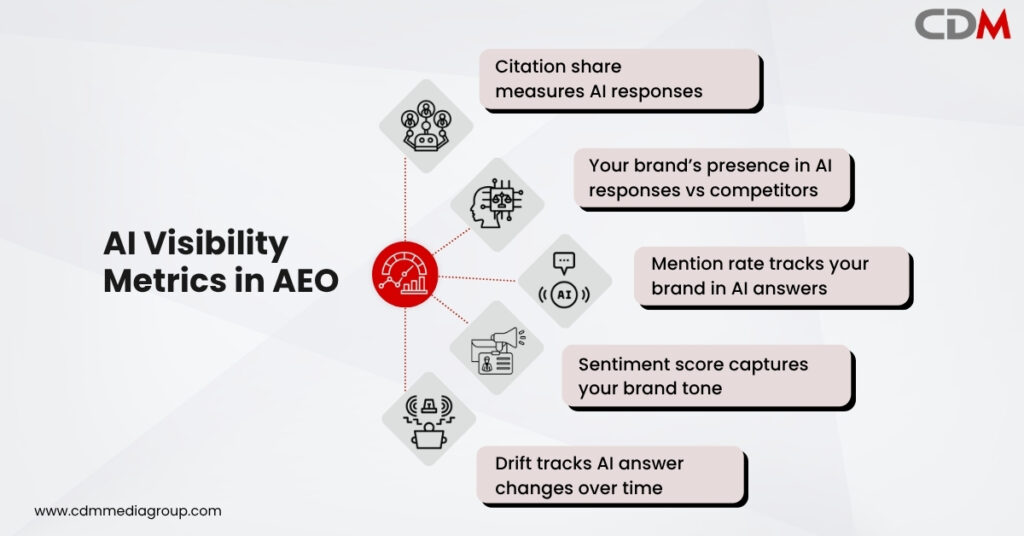
Most dashboards offer dozens of numbers. In practice, five indicators provide the clearest signals.
1. Citation share
Citation share measures how often AI responses cite your content compared to competitors for a specific set of prompts.
If you test 100 prompts and generative search optimization cites you 18 times while citing a competitor 47 times, the picture becomes clear.
Low citation share usually points to shallow content, outdated pages, or unclear answers to common questions. It signals where refreshes and structural improvements will make the most significant difference in generative search optimization.
2. Competitive share of voice
Share of voice tracks how often your brand appears versus competitors across relevant AI queries.
You might dominate technical topics while a competitor controls introductory guides. Tracking these patterns helps you decide where to defend existing ground and where to expand coverage.
3. Mention rate
Mention rate tracks how often your brand name appears in AI-generated answers.
Many purchase decisions begin with an unlinked recommendation. Because most AI mentions originate from third-party sources, mention rate often reveals how well your reputation travels beyond your own content.
4. Sentiment score
A sentiment score captures the tone AI models use when they describe your brand.
An AI system might mention you frequently but frame you poorly. It might highlight missing features, outdated information, or unfavorable comparisons. Tracking sentiment helps you catch those narratives early and correct the underlying content.
5. Drift and volatility
Drift tracks how AI-generated answers change over time. As models retrain on new data, their brand descriptions evolve.
A sudden drop in citations usually signals one of three issues:
- Competitors published stronger content
- Your pages grew outdated
- Models learned new information that changed how they answered.
- Regular monitoring helps you respond before negative shifts become the default story.

Content as Strategy, Not Just a Task: Evaluating Its True Value in the Age of AEO
Content is no longer a task relegated to interns and freelancers. It’s a growth function central to brand building, demand generation, and revenue acceleration. If you handle CaaS with the proper infrastructure and intent, it can become your most scalable and effective content marketing lever.
If you’re ready to stop treating content like a blog mill and start treating it like a growth engine, ‘Content as a Service’ is your next move.
CDM is built for organizations like yours: tech-forward, ambitious, and ready to lead with content.
Let’s create intelligent content together.
FAQs
1. What is content ROI in AI search?
Content ROI in AI search measures the value generated from AI citations, mentions, and brand visibility beyond traditional website traffic.
2. Why are traditional SEO metrics less effective for AI search?
AI-generated answers reduce clicks, making visibility and brand mentions more important than rankings alone.
3. How do you measure success in AI-generated search results?
Content success is measured through citation share, share of voice, mention rate, sentiment, and answer visibility.
4. What is citation share in generative search optimization?
Citation share tracks how often AI platforms reference your content compared to competitors.
5. How can brands improve content ROI in AI search?
Brands can improve content ROI by creating authoritative, up-to-date, and AI-friendly content that earns citations and mentions.