
You’ve got a Slack workspace with 847 members. Your Discord...
Read More



International SEO Strategy: Common Mistakes SaaS Companies Should Avoid
A market research study projects that the global SEO market...
Read More

How to Create Sales Enablement Content for Every Stage of the B2B Buyer’s Journey
According to Gartner’s 2026 sales survey, 67% of B2B buyers...
Read More
How B2B Podcast Marketing Builds Authority and Drives Pipeline
Podcasting has become an increasingly important channel for brands looking...
Read More
How B2B Video Marketing Improves Brand Trust and Sales Conversions
Think about the last time you considered buying a B2B...
Read More
You Don’t Know You are Scaling Until the Questions Change
A founder asks, ‘Can we do it?’ A scaling company...
Read More
Schema Markup for SEO: Essential Structured Data Every B2B Website Needs
According to the July 2026 Schema.org usage dataset, 5,545 Schema.org...
Read More
How a Sportsman’s Mindset Shapes Business Growth
What can building a business learn from building an athlete?...
Read More
How to Build a LinkedIn Marketing Strategy That Generates High-Quality B2B Leads
A strong LinkedIn marketing strategy is necessary if you want...
Read More
The Ultimate List of AI Search Optimization Tools for 2026
Your brand’s reputation is now stored in a new algorithm...
Read More
How to Structure Content So AI Models Can Understand and Cite It
Improve the structure of your AI overviews to increase visibility in AI search results. Learn how to modify your content strategy, optimize for AI models, and produce AI-friendly content. This guide will help you dominate AI-readable content.
Hey, there! So, you want to adapt your AI content structuring for an AI overview and have your content appear in those snazzy AI search results, right? You are in the right place. Let’s face it: the world of content is changing faster than ever, and if you don’t keep up with AI, you’ll fall behind. This is more than just sprinkling in a few keywords; it is about completely rethinking how you structure your content. Are you ready to dive in? Let’s get started.
Why AI Content Structuring Matters More Than Ever
Traditional SEO content structure focused on AI-readable content and on-page signals. Headers helped users scan. Lists broke up walls of text. These were nice-to-haves.
The answer engine optimization structure is functional. AI systems can’t do your page the way a human does. They parse it algorithmically, looking for passages they can extract and use as part of a synthesised answer. If your content is structured for extraction, it gets cited. If it’s not, it gets skipped, even if the information is excellent.
ChatGPT’s citation patterns showed that the first 30% of a page accounted for 44% of all citations and that cited passages were nearly twice as likely to use definitive language as hedged or vague framing. Structure is not aesthetic. It is the process by which AI systems select sources.
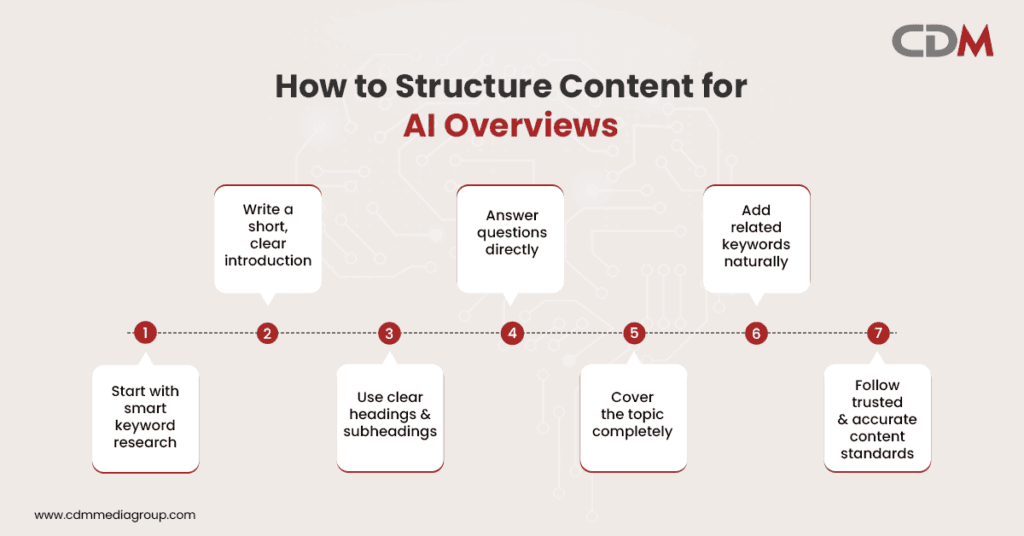
How to structure content for ChatGPT and AI search engines (Step-by-Step)
Okay, let’s get to the details. Here’s a useful guide to structuring your content for maximum AI visibility:
Start with Keyword Research
Keyword research is still important in traditional SEO. However, you must think beyond simply finding popular keywords. Concentrate on identifying the questions your intended audience is asking. What problems are they attempting to solve? Use content optimization tools for LLMs to help you find these questions and understand their meaning.
SEMrush, Ahrefs, and Google Keyword Planner can help you find these hidden gems. Consider using AI-powered tools to analyze search queries and find patterns.
Write a clear and concise introduction
Your introduction is your chance to hook both the AI and the user. Clearly state your content’s purpose and what the reader will learn. Use your target keyword in the first paragraph, but avoid stuffing it in awkwardly. Make it natural and engaging.
Use Headings and Subheadings Strategically
For AI, headings and subheadings function similarly to road signs. They explain to the AI what each section of your content is about. Use them to separate your text and make it easier to scan. Use descriptive and keyword-rich headings to accurately reflect the contents of each section.
Below are some examples of effective headings:
- How to structure content for ChatGPT and AI search engines?
- “How to Implement Artificial Intelligence in Your Content Creation Process.”
- “Top 5 AI Tools for Content Creators.”
Answer Questions Directly
AI overviews are all about giving answers. Make sure your content directly answers the questions your target audience is asking. Use question-based headings and subheadings to indicate to the AI that you’re about to respond.
For example:
What is AI-Powered Drug Discovery?
AI-driven drug discovery uses artificial intelligence to accelerate and enhance the discovery and development of new drugs.
Provide Comprehensive Coverage
Do not just scratch the surface. Dive deeply into the subject and provide a comprehensive overview. Cover all the important points and provide context. The more comprehensive your content, the more likely it will be included in an AI overview.
Optimize for Semantic Relevance
Semantic relevance means ensuring that your content is contextually relevant to the user’s query. Use synonyms and related terms to enrich your AI-readable content and demonstrate to the AI that you understand the subject thoroughly.
For example, if your target keyword is “content creation,” you might also include terms like “content marketing,” “content writing,” and “digital content.”
Adhere to Ethical and Editorial Standards
AI is becoming smarter, but it is not perfect. It is still possible to trick it into spreading misinformation or biased content, so strict ethical and editorial standards must be followed.
Technical Requirements for AI Crawler Access
Robots.txt Configuration: Controlling Bot Access and Permissions
Correct robots.txt settings allow AI bots like GPTBot and OAI-SearchBot to index your content for citations. Unlike standard search bots, these require specific permissions. Grant access to these specialized crawlers while managing page-level control.
Facilitate crawling by removing restrictive disallow rules on vital content. A dedicated AI sitemap can highlight high-value resources such as FAQs and data-rich articles.
Schema Markup Implementation for Context
Schema markup offers vital context for AI crawlers to categorize your work. Using schema.org structured data to define authorship, dates, and categories helps AI models establish content authority.
Prioritize FAQ, article, and organization schemas, as these align with the data AI models use for citations. Correct implementation increases your chances of being cited by clarifying your content’s purpose.
Summary
AI search is reshaping online visibility, requiring content optimization for LLMs for both users and AI systems. Elements like clear headings, direct answers, and schema markup are essential for appearing in AI overviews. Early adopters will gain authority and a competitive edge in this evolving landscape.
CDM Media Group assists by creating AI-optimized strategies, SEO/AEO solutions, and digital campaigns to boost brand visibility on AI search platforms. They help businesses rank in Google AI Overviews and future-proof content strategies by showing how to structure content for ChatGPT and AI search engines.

FAQs
1. What is AI content structuring?
AI content structuring is the process of organizing content so AI models can easily understand, extract, and cite information.
2. Why are headings important for AI search?
Clear headings help AI identify topics quickly and understand the hierarchy of information on a page.
3. How can schema markup improve AI visibility?
Schema markup provides structured context that helps AI systems interpret and categorize content accurately.
4. What type of content is most likely to be cited by AI?
Content that provides direct, factual, and well-structured answers is more likely to be cited by AI models.
5. Does traditional SEO still matter for AI search
Yes, traditional SEO remains important, but it should be combined with AI-friendly formatting, semantic relevance, and clear answer-focused content.