
You’ve got a Slack workspace with 847 members. Your Discord...
Read More



International SEO Strategy: Common Mistakes SaaS Companies Should Avoid
A market research study projects that the global SEO market...
Read More

How to Create Sales Enablement Content for Every Stage of the B2B Buyer’s Journey
According to Gartner’s 2026 sales survey, 67% of B2B buyers...
Read More
How B2B Podcast Marketing Builds Authority and Drives Pipeline
Podcasting has become an increasingly important channel for brands looking...
Read More
How B2B Video Marketing Improves Brand Trust and Sales Conversions
Think about the last time you considered buying a B2B...
Read More
You Don’t Know You are Scaling Until the Questions Change
A founder asks, ‘Can we do it?’ A scaling company...
Read More
Schema Markup for SEO: Essential Structured Data Every B2B Website Needs
According to the July 2026 Schema.org usage dataset, 5,545 Schema.org...
Read More
How a Sportsman’s Mindset Shapes Business Growth
What can building a business learn from building an athlete?...
Read More
How to Build a LinkedIn Marketing Strategy That Generates High-Quality B2B Leads
A strong LinkedIn marketing strategy is necessary if you want...
Read More
The Ultimate List of AI Search Optimization Tools for 2026
Your brand’s reputation is now stored in a new algorithm...
Read More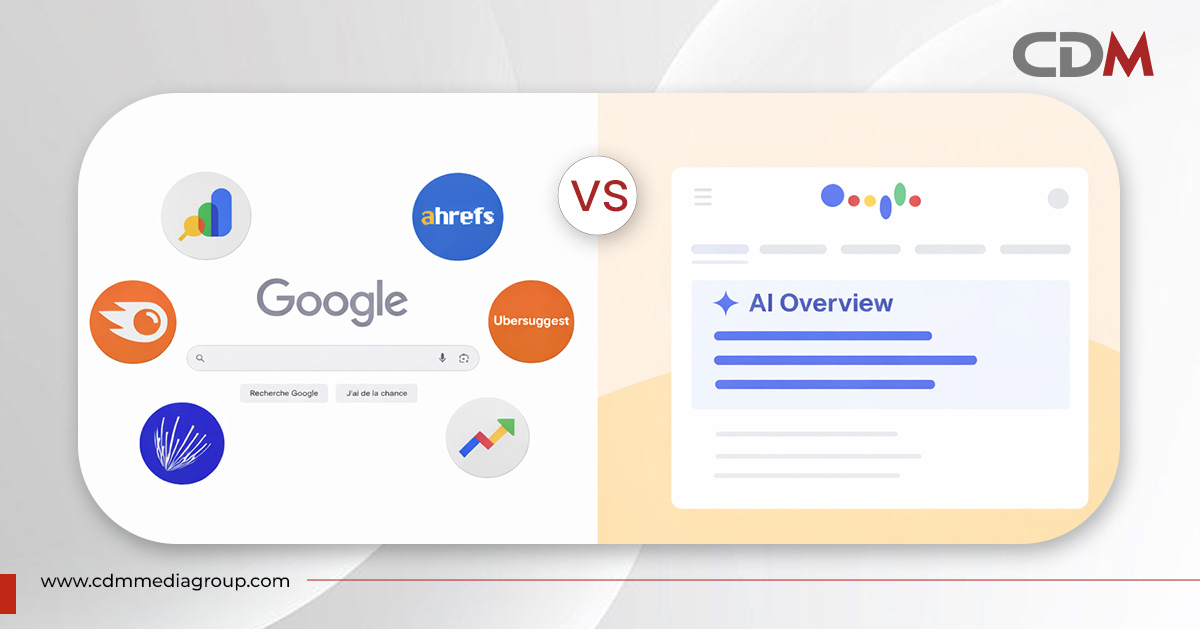
If you notice, the whole internet search process has been undergoing major transformations since Google launched in 1998. SEO best practices in 2026 have moved beyond keyword stuffing and mass link building, focusing instead on a consistent strategy that aligns with user intent and business goals.
Search is evolving beyond traditional Search Engine Optimization (SEO) toward Answer Engine Optimization (AEO), where content is designed to deliver direct, AI-generated answers across platforms like ChatGPT, Perplexity, Claude, and Gemini.
According to the Conductor’s benchmark report, AI traffic accounts for just 1.08% of all website visits across 13,770 domains. Meanwhile, organic search continues to deliver 53% of traffic on this domain, with healthcare accounting for 42.4% and communication services for 39.6%.
Now, are you thinking about the major difference between SEO and AEO, and what organizations should actually be doing differently now?
SEO vs AEO: Understanding the Core Concepts
What is SEO?
Think of SEO as the invisible infrastructure that determines whether your content gets discovered or ignored in a crowded digital ecosystem. It is a strategic discipline that aligns your content with how platforms such as Google and Bing retrieve, interpret, and prioritize information.
Modern SEO goes beyond rankings to focus on semantic relevance, structured content, and authority signals. By making content optimized for algorithmic processing through techniques such as schema markup, it enables both search engines and AI systems to extract and present information accurately. Today, SEO is less about visibility alone and more about becoming a trusted source that powers answers.
What is AEO?
AEO reflects a fundamental shift in how digital visibility is earned and measured. Instead of optimizing for clicks, it focuses on ensuring content is directly surfaced as the most relevant response within AI-driven interfaces and voice-enabled environments. As platforms like Google and OpenAI increasingly prioritize instant answers, the emphasis moves from ranking to real-time content selection.
This requires a disciplined approach to content design, centered on precision, structure, and intent alignment. By leveraging structured data, semantic clarity, and contextual depth, AEO enables content to be accurately interpreted and delivered as authoritative responses. The outcome is enhanced visibility, stronger credibility, and a sustained position as a trusted source in an AI-first search ecosystem.
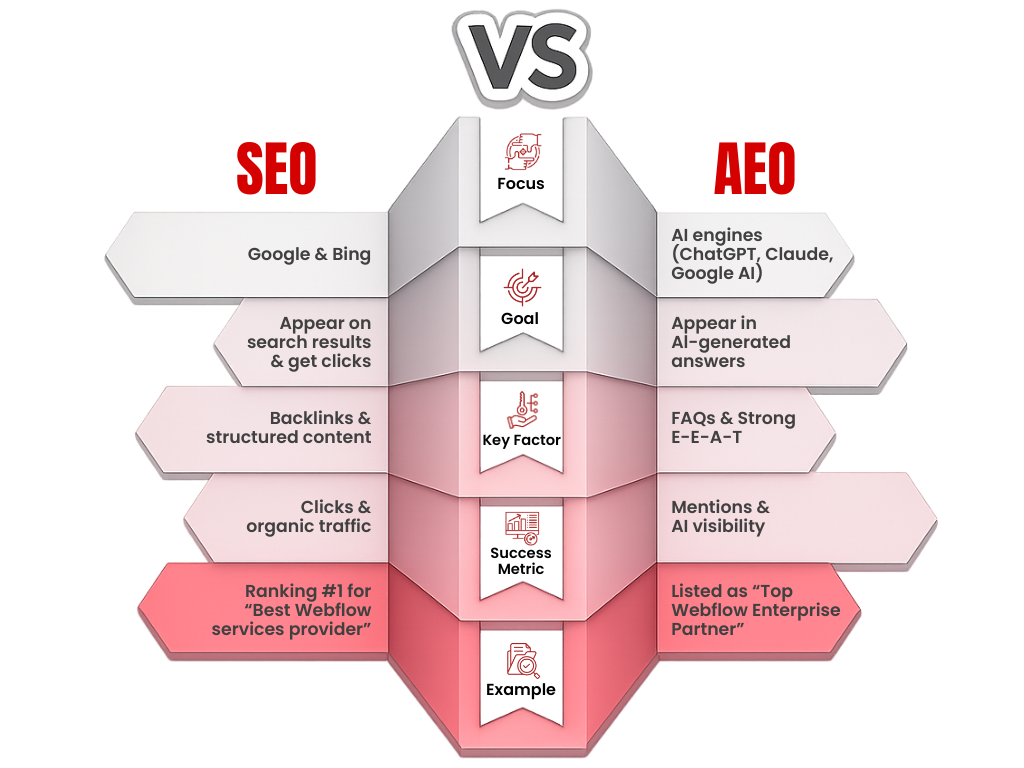
SEO vs AEO: Key Differences
In short, SEO optimizes for the ‘Search Page,’ whereas AEO optimizes for the ‘Answer.’ The objective of both is to build trust, but the methods used to achieve this differ.
Optimizing your Content with Structured Answers for AI Search
AI chatbots don’t read a page top to bottom as a person would. They break content into smaller, usable, or important pieces, a process called parsing. These small pieces are what get ranked and gathered into structured answers for AI search.
Titles, Descriptions, and H1 Tag
- Your page title, description, and H1 tag (the top-level HTML heading) are important signs for AI search engines to use to explain the purpose and scope of your page.
- Page titles should clearly summarize what the content delivers, using simple language that aligns with search intent.
- Descriptions help AI and users understand the blog’s context. Avoid keyword stuffing; instead, explain the value or outcome.
- H1 tags work as your content’s headline. They should match (or closely show) the page title while setting clear expectations for what follows. The corresponding integration between title, H1, and description improves visibility of structured answers for AI search.
Example:
1. Title: “Best SEO Strategies for Small Business Websites”
2. H1: “SEO Plan That Helps Small Businesses Get Found Online”
3. Description: A practical guide covering the necessary SEO strategies small businesses need to improve their online visibility, attract local customers, and compete with bigger brands without a big budget.
Headings (H2s and H3s):
Headings are HTML tags (<h2>, <h3>) that mark where one idea ends and another begins. For AI, they work like chapter titles that define structured answers for AI search.
Example: Instead of an unclear heading like “Learn More,” use “Why is SEO Important for Your Website or Business?”
Questions and Answer Formats
Direct questions with clear answers show the way people search. Chatbots can often get these pairs word-for-word into structured answers for AI search responses.
Example:
Q: How does this SEO tool compare to others in terms of speed?
A: It crawls and analyzes your site in under 60 seconds, which is significantly faster than most SEO tools on the market.
Lists and Tables
Bulleted lists, numbering steps, and differentiation tables break complex details into clean, reusable portions. They’re especially effective for how-to queries and feature comparisons like the difference between SEO and AEO.
| Weak Example | Strong Example |
| A blog post that repeats the same keyword 50 times but has no backlinks, slow load speed, and zero useful content. | Major list of top 3 SEO features: Keyword Optimization Backlink Building Technical SEO |
How AI Engines actually Optimize your Blog Content for Generative AI search visibility
AI doesn’t structure truth; it comes from web search. Key factors:
- Crawling and indexing (open web engines, where authorized).
- Source authority: Content from official domains with established sources (academia, trusted publishers, and official sources).
- Structured data and clarity make it easier to optimize your blog content for generative AI search.
- Engagement metrics (backlinks, dwell time, shares) help to recognize credibility or trustworthiness.
If your content is small, unstructured, or lacks trustworthy sources, AI engines are less likely to optimize your blog content for generative AI search.
Real-World Examples
Let’s look at a few real-world examples to understand how industries are leveraging SEO and AEO effectively for the growing opportunity.
1. SaaS Enterprises Using SEO and AEO
A SaaS company shifting from WordPress to Webflow AI (or another systematic content tool) to create content with an FAQ structure. They maintained SEO rankings and began showing up in AI responses for long-tail queries with structured answers for AI search.
2. SaaS Organizations Missing the AEO Opportunity
Another enterprise used AI-generated content for landing pages without verification, expert voices, or a structured format to optimize blog content for generative AI search. As a result, competitors with stronger structure and authorities to start working in AI answers; this company lost visibility both in SERPs and in structured answers for AI search for some search categories.

Ready to Transform SEO Into AEO Visibility
Your content strategy must develop to stay visible in the age of AI search. At CDM Media Group, offer effective SEO and AEO solutions designed for ambitious B2B brands. We see them as two equal parts: the foundational SEO and the future edge AEO. Both matter because the way people search is changing, but their requirement for trustworthy, authoritative answers has never been higher.