You’ve got a Slack workspace with 847 members. Your Discord...
Read More



International SEO Strategy: Common Mistakes SaaS Companies Should Avoid
A market research study projects that the global SEO market...
Read More

How to Create Sales Enablement Content for Every Stage of the B2B Buyer’s Journey
According to Gartner’s 2026 sales survey, 67% of B2B buyers...
Read More
How B2B Podcast Marketing Builds Authority and Drives Pipeline
Podcasting has become an increasingly important channel for brands looking...
Read More
How B2B Video Marketing Improves Brand Trust and Sales Conversions
Think about the last time you considered buying a B2B...
Read More
You Don’t Know You are Scaling Until the Questions Change
A founder asks, ‘Can we do it?’ A scaling company...
Read More
Schema Markup for SEO: Essential Structured Data Every B2B Website Needs
According to the July 2026 Schema.org usage dataset, 5,545 Schema.org...
Read More
How a Sportsman’s Mindset Shapes Business Growth
What can building a business learn from building an athlete?...
Read More
How to Build a LinkedIn Marketing Strategy That Generates High-Quality B2B Leads
A strong LinkedIn marketing strategy is necessary if you want...
Read More
The Ultimate List of AI Search Optimization Tools for 2026
Your brand’s reputation is now stored in a new algorithm...
Read More
Data systems see the world in terms of rows and columns. A knowledge graph optimization for SEO sees it as a set of connections. It treats information the way people do, through relationships that have meaning. Customers link to purchases. Products link to suppliers. Events, locations, and teams all connect in ways that tell a story with knowledge panel visibility.
When those links come together, business efforts start to click. You can follow a customer’s journey from first touch to repeat purchase. You can see how geography affects demand or how product changes impact supply chains. Suddenly, your questions get smarter and the answers more useful.
That’s why knowledge graphs sit behind so many intelligent systems: product recommendations that feel intuitive and search engines that understand intent for entity SEO for AI search. They make context part of the data itself. And you don’t have to boil the ocean to get there. Start by connecting a few datasets, such as customer and product information. Expand as you see results.
What is knowledge graph optimization?
Knowledge graph optimization is the systematic process of improving a knowledge graph’s structure, relationships, and functionality to ensure it delivers accurate, relevant, and actionable insights. A knowledge graph is a network of interconnected entities (nodes) and their relationships (edges), often used to represent real-world data in a machine-readable format. Knowledge graph optimization for SEO ensures that this network is not only accurate but also efficient, scalable, and aligned with its users’ specific needs.
Key Components of Knowledge Graph Optimization for Knowledge Panel Visibility
To optimize a knowledge graph effectively, it’s essential to understand its core components:
- Nodes (Entities): Represent real-world objects, concepts, or data points. Examples include people, places, products, or events.
- Edges (Relationships): Define the connections between nodes, such as “is a friend of,” “is located in,” or “is manufactured by.”
- Attributes: Provide additional information about nodes or edges, such as a person’s age or a product’s price.
- Ontology: The schema or structure that defines the types of entities, relationships, and attributes in the graph.
- Data Sources: The origin of the data used to populate the graph, such as databases, APIs, or web crawlers.
- Algorithms: Used for tasks such as entity resolution, relationship extraction, and graph traversal to ensure the graph is accurate and efficient.
By focusing on these components, professionals can identify areas for improvement and implement targeted optimization strategies.
How Can You Audit an Entity’s SEO for AI Search Using Knowledge Graph Principles?
You don’t improve what you don’t measure. And AI search entity optimization is fragmented across engines.
Start with a simple AI search visibility. Audit Checklist:
- Can AI systems retrieve your pages reliably (crawlability, indexation, rendering)?
- Can they extract answers easily (structure, chunking, headings, summaries)?
- Do your pages clearly communicate entities (who/what this page is about)?
- Is your structured data accurate and complete (organization, article, FAQ page, product, where relevant)?
- Are your brand mentions growing across credible domains?
- Are you tracking where you appear across engines (Google AI experiences, ChatGPT-style assistants, etc.)?
At this point, many teams add a monitoring layer. For example, positions itself as a “single source of truth” for multi-engine visibility signals, including citation-based measurement. That can speed up auditing because you don’t have to manually check dozens of prompts across platforms.
Step-by-Step Guide to Knowledge Graph Optimization For AI Search
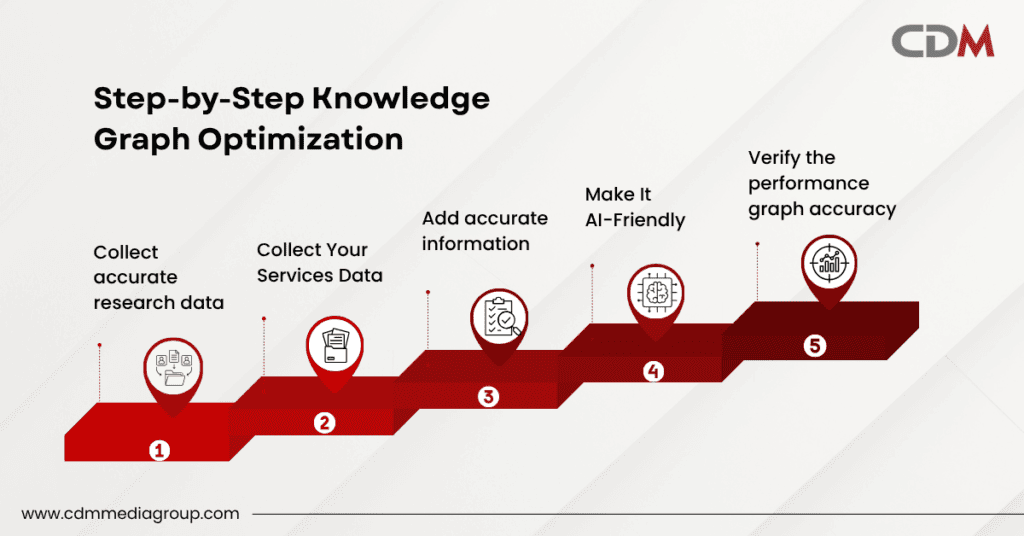
- Define Objectives: Identify the goals of your knowledge graph, such as improving search relevance, enhancing customer insights, or streamlining operations.
- Collect and Clean Data: Gather data from relevant sources and preprocess it to remove duplicates, inconsistencies, and errors.
- Design the Ontology: Create a schema that defines the types of entities, relationships, and attributes in your graph.
- Optimize Relationships: Use algorithms to refine connections, resolve ambiguities, and ensure accuracy.
- Implement Scalability Measures: Use indexing, partitioning, and caching to handle large datasets and ensure fast query performance.
- Test, Monitor, and Update: Evaluate the graph’s accuracy, relevance, and usability using user feedback and performance metrics. Continuously monitor the graph for changes in data, user needs, or system requirements, and update it accordingly.
How the Knowledge Graph Optimizations Power AI search entity optimization
Google’s Knowledge Graph helps identify entity SEO for AI search and relationships, and it helps determine which SERP features appear. It enables smarter, more organized, and context-rich search results.
Knowledge Panels
The knowledge panel visibility provides quick factual information about an entity’s SEO for AI search, including descriptions, biographies, and related entities. Data comes from trusted public sources, licensed databases, websites with strong E-E-A-T, and verified organizations.
People Also Search For (PASF)
PASF helps users explore related entities or refine their searches. It differs from People Also Ask (PAA), which focuses on answering questions instead of suggesting related topics.
Related Entities
Google uses entity SEO for AI search to show context-specific results, such as songs, events, businesses, or organizations related to the main search query.
AI Overviews & Featured Snippets
Featured snippets pull direct answers from a single source, while AI Overviews generate broader summaries using multiple sources and entity relationships powered by the Knowledge Graph and Google’s Gemini AI.
Shopping Graph for Products
For product-based searches, Google uses the Shopping Graph instead of the Knowledge Graph. It powers transactional search results with frequently updated merchant and product data.
What are the common knowledge graph types?
A knowledge graph highlights information about a wide range of entities. Broadly, they can be divided into a few common types:
People: This could be notable individuals, celebrities, historical figures, etc. For example, if you search for “Albert Einstein,” you’ll get a knowledge panel displaying his bio, related images, quotes, and other relevant information.
Events: These are specific happenings, historical or pending, like “Super Bowl” or “Olympics 2024.” The Knowledge Graph would display related information, such as dates, participants, and outcomes.
Organizations: Information entities about companies, institutions, or groups. Type in “Google Inc.,” and you’ll see information about its founder, headquarters, CEO, subsidiaries, and much more.
Places: This can include countries, cities, or landmarks. For instance, if you search for “Statue of Liberty,” a knowledge panel’s visibility shows its history, images, location, and even operating hours.
Facts and Stats: This includes any definitive or statistical information, such as “world population” or “height of Mount Everest.”

Key Takeaways
Knowledge Graph Optimization for SEO is becoming essential for improving visibility in AI search entity optimization. By strengthening entity relationships, structured data, and content relevance, businesses can enhance their presence across knowledge panel visibility, AI Overviews, featured snippets, and other SERP features. As search engines continue to evolve toward an entity SEO for AI search, investing in KGO will help brands stay discoverable, authoritative, and competitive in the future of search.
Let’s connect to rethink how knowledge graph optimization for SEO performs in today’s AI-driven landscape.
FAQs
1. What is knowledge graph optimization in SEO?
Knowledge graph optimization is the process of improving entity relationships, structured data, and content signals to help search engines better understand and display your brand.
2. How does a knowledge graph improve AI search visibility?
It helps AI systems connect entities, understand context, and surface your content in AI overviews, knowledge panels, and other search features.
3. Why are entities important for AI search?
Entities provide clear, machine-readable information about people, places, brands, and topics, making content easier for AI to interpret and rank.
4. Can structured data help with knowledge graph optimization?
Yes, accurate schema markup strengthens entity recognition and increases the chances of appearing in rich results and knowledge panels.
5. What are the benefits of knowledge graph optimization for businesses?
Knowledge graph optimization improves brand authority, search visibility, content discoverability, and performance across AI-powered search experiences.