You’ve got a Slack workspace with 847 members. Your Discord...
Read More


International SEO Strategy: Common Mistakes SaaS Companies Should Avoid
A market research study projects that the global SEO market...
Read More

How to Create Sales Enablement Content for Every Stage of the B2B Buyer’s Journey
According to Gartner’s 2026 sales survey, 67% of B2B buyers...
Read More
How B2B Podcast Marketing Builds Authority and Drives Pipeline
Podcasting has become an increasingly important channel for brands looking...
Read More
How B2B Video Marketing Improves Brand Trust and Sales Conversions
Think about the last time you considered buying a B2B...
Read More
You Don’t Know You are Scaling Until the Questions Change
A founder asks, ‘Can we do it?’ A scaling company...
Read More
Schema Markup for SEO: Essential Structured Data Every B2B Website Needs
According to the July 2026 Schema.org usage dataset, 5,545 Schema.org...
Read More
How a Sportsman’s Mindset Shapes Business Growth
What can building a business learn from building an athlete?...
Read More
How to Build a LinkedIn Marketing Strategy That Generates High-Quality B2B Leads
A strong LinkedIn marketing strategy is necessary if you want...
Read More
The Ultimate List of AI Search Optimization Tools for 2026
Your brand’s reputation is now stored in a new algorithm...
Read More
The Click Is No Longer the Point
Website traffic used to be the easiest way to judge content. More visits, better content. Simple.
That’s not how it works anymore.
People find your brand in a Google snippet, an AI summary, a LinkedIn post, or a quoted line in someone’s newsletter and never visit your site. That’s not failure. That’s just how content moves now.
Zero-click content is content that delivers value right where people already are. The job isn’t to pull everyone back to your website. It’s to show up where the conversation is happening and say something worth remembering.
Why Your Off-Site Content Strategy Matters More Than Ever
Search engines and AI tools are built to answer questions on the spot. Google’s featured snippets, AI Overviews, and knowledge panels grab your content and surface it directly. The user gets their answer. You get no click, but you do get the credibility of being the source.
Social platforms work the same way. LinkedIn, Instagram, and YouTube all want people to stay put. A post that gets 200 comments and 80 shares might send zero traffic to your site. But something clearly landed.
Your content might be:
- Showing up in an AI-generated answer
- Getting screenshotted and shared in group chats
- Quoted in an industry newsletter
- Referenced in a conversation you’ll never see
None of that appears in your analytics. All of it is doing something real.
Content Reach Beyond the Website: What to Measure
The answer isn’t to throw out your metrics. It’s to add the ones that reflect where your content is actually performing.
Off-Platform: Where Zero-Click Value Shows Up
- Brand Mentions & Citations
Are people referencing your brand, content, or team? Tools like Google Alerts, Mention, and Brandwatch can help you track these mentions. Being cited in an AI summary or a respected newsletter signals that you’re viewed as a credible source.
- Social Engagement Rate
Likes, comments, shares, and saves divided by your follower count. This metric shows whether your content is resonating with your audience, not just reaching them. A post with no link but strong engagement can still be highly valuable.
- Saves
An often-overlooked signal. When someone saves a post, they’re indicating they want to revisit it later. That reflects intent and trust, making saves worth tracking.
- Share of Voice in AI Results
Tools like Perplexity and Google’s AI Overviews draw from trusted sources. If your content is being cited in AI-generated answers related to your core topics, you’re gaining meaningful visibility even without generating clicks.
- Newsletter & Syndication Pickup
If other writers, newsletters, or publications are quoting your content, that’s earned authority. It shows your insights are valuable enough to be shared and amplified by others.
On-Site: Still Matters, Just Reframed
When people do visit your site, often after encountering your brand multiple times elsewhere, these metrics reveal whether your content is engaging and delivering value.
Scroll Depth & Session Duration If someone actually reads what you wrote, you’ll see it here. Intentional visitors who spend time are more valuable than high volume with low engagement.
Bounce Rate by Content Type Don’t look at bounce rate as one number. A blog post and a landing page behave differently. Knowing which formats keep people around tells you where to put your energy.
CTA Click-Through Rate When your content asks someone to do something, do they? High CTR means the content builds enough trust to prompt action.
Returning Visitors People come back when you’ve earned it. Watch this ratio over time, it’s one of the clearest signs you’re building a real audience, not just capturing passersby.
Measuring Content ROI Without Visits
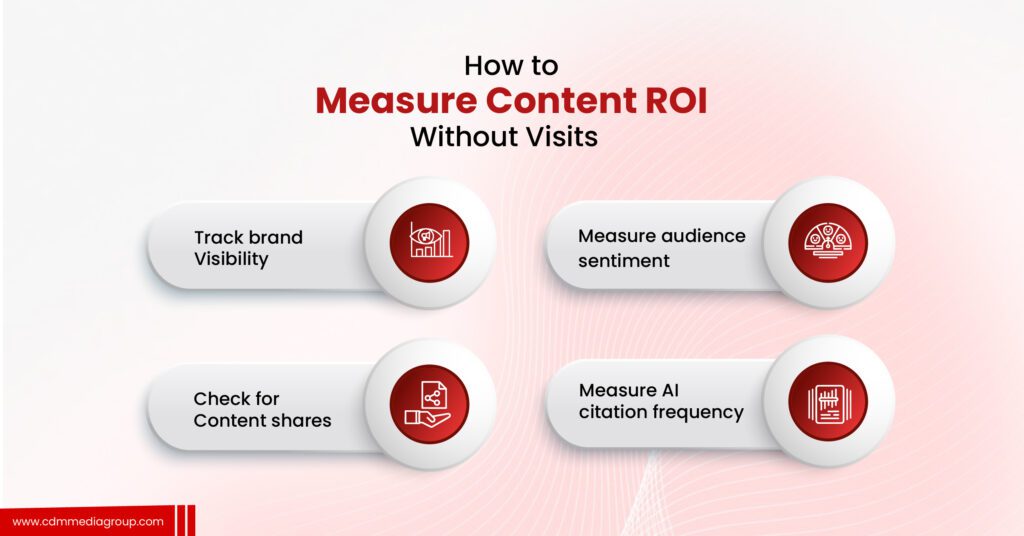
This is where most teams get stuck. If someone reads your content in an AI result, shares it as a screenshot, or quotes it in a Slack message, there’s no session, no pageview, no trail in your dashboard.
So how do you make the case that it’s working?
You build a parallel measurement layer. Alongside your usual analytics, you track:
- Mention volume: is your brand coming up more over time?
- Sentiment: are those mentions positive, neutral, or critical?
- AI citation frequency: are you appearing in AI-generated answers for your key topics?
- Earned amplification: newsletters, roundups, and reposts that you didn’t pay for
These don’t replace click data. They fill in what click data misses. Together, they give you a more honest picture of what your content is actually worth.
How Do You Measure Content Success Without Website Visits?
Start by accepting that some value will always be invisible. A conversation sparked by your content, a recommendation made because someone remembered your post, those don’t show up anywhere. That’s okay.
What you can track is influence at scale. Here’s a simple approach:
- Set a baseline first: Pick two or three off-platform metrics, brand mentions, engagement rate, and saves are a good starting point. Record where they sit today.
- Check them consistently: Monthly is enough. You’re looking for directional trends, not daily fluctuations.
- Connect them to business outcomes: If mention volume rises in the same quarter pipeline improves, that’s a signal worth noting. Correlation isn’t proof, but patterns add up.
- Ask your audience directly: A simple “how did you hear about us?” fields in a form will surface channels your analytics never will. Word of mouth and AI discovery rarely leave a digital footprint.
- The goal isn’t perfect attribution: It’s building enough evidence, over time, that your off-site content strategy is creating real momentum, even when the clicks don’t show it.
Picking the Right Metrics for You
Not every metric above will fit your business. The goal is to match what you measure to what you’re actually trying to do.
A few questions worth asking:
- Are we focused on awareness, leads, or keeping existing readers engaged?
- Where does our audience actually spend time; search, social, email, communities?
- Do we have the tools to track off-platform activity right now?
A B2B brand building thought leadership will care most about citations, AI mentions, and newsletter pickups. A consumer brand will lean on engagement rate and saves. Both are right as long as the metrics match the goal.
The Real Goal
The brands doing well at content right now aren’t always the ones with the most traffic. They are the ones people think of when a question comes up in a conversation, in an AI result, in someone’s group chat.
That kind of presence builds slowly. But it compounds. And it makes everything else, from your campaigns and sales conversations to your partnerships, easier over time.
Traffic is still part of the picture. But it’s one part. The bigger goal is becoming the source people trust, not just the link they clicked.

Want Help Getting There?
At CDM Media Group, this is what we focus on: helping brands understand where their content is truly making an impact, both on-site and off-site, and building strategies that reflect the complete picture.
If your current approach only tracks website visits, you’re probably underselling what your content is doing.
Let’s change that. Reach out to CDM Media Group and let’s build something that measures what actually matters.
FAQs
Q. What is zero-click content and why does it matter?
A. It’s content people read without clicking through to your site. A Google snippet, an AI answer, a LinkedIn post. Most content is consumed this way now, so if you’re only tracking visits, you’re missing most of what’s actually working.
Q. How do you measure content ROI without website visits?
A. Track brand mentions, saves, engagement rate, and newsletter pickups. None are perfect alone, but together they show whether your content is actually making an impact.
Q. What off-site content metrics should I be tracking?
A. Start with brand mentions and social engagement rate. Then add saves and check if your content is appearing in AI-generated answers. Two or three right metrics beat ten wrong ones.
Q. Does website traffic still matter in an off-site content strategy?
A. Yes, but it’s not the whole story. When people do visit, look at scroll depth and session time. That tells you far more than visit count alone.
Q. How do I know if my off-site content strategy is actually working?
A. Mentions go up. More saves. Your name shows up in places you didn’t put it. And just ask new leads how they found you. The answer is often “someone mentioned you” or “I saw you in an AI result.”