You’ve got a Slack workspace with 847 members. Your Discord...
Read More



International SEO Strategy: Common Mistakes SaaS Companies Should Avoid
A market research study projects that the global SEO market...
Read More

How to Create Sales Enablement Content for Every Stage of the B2B Buyer’s Journey
According to Gartner’s 2026 sales survey, 67% of B2B buyers...
Read More
How B2B Podcast Marketing Builds Authority and Drives Pipeline
Podcasting has become an increasingly important channel for brands looking...
Read More
How B2B Video Marketing Improves Brand Trust and Sales Conversions
Think about the last time you considered buying a B2B...
Read More
You Don’t Know You are Scaling Until the Questions Change
A founder asks, ‘Can we do it?’ A scaling company...
Read More
Schema Markup for SEO: Essential Structured Data Every B2B Website Needs
According to the July 2026 Schema.org usage dataset, 5,545 Schema.org...
Read More
How a Sportsman’s Mindset Shapes Business Growth
What can building a business learn from building an athlete?...
Read More
How to Build a LinkedIn Marketing Strategy That Generates High-Quality B2B Leads
A strong LinkedIn marketing strategy is necessary if you want...
Read More
The Ultimate List of AI Search Optimization Tools for 2026
Your brand’s reputation is now stored in a new algorithm...
Read More
You’ve got a Slack workspace with 847 members. Your Discord sees daily activity. You’re running monthly webinars. But when leadership asks, “What’s this community actually doing for us?” can you point to the impact it’s having on your business?
That’s where many community teams struggle. The activity is there, but connecting it to meaningful business results is a different challenge. Lots of activity. Lots of activity and energy, but no clear link between people talking and the business actually growing. Most teams skip the best practices for community-led growth and hope engagement somehow becomes revenue.
When Community-led growth strategies are implemented correctly, these strategies reduce customer acquisition costs while increasing lifetime value through member advocacy.
The solution isn’t working harder…it’s building better systems.
What Is Community-Led Growth and Why It Matters
You can have thousands of users and still lose them because they never figure out how to get real value from your product. Some struggle with basic features, others give up when they hit a roadblock, and many leave without asking for help.
When users share solutions, exchange practical tips, and learn from each other’s experiences, they have more reasons to keep using the product. That’s how community-led growth (CLG) can turn customer conversations into better product adoption, stronger customer success, and long-term retention.
How to build community-led growth for a B2B SaaS brand
Most B2B communities fail because they focus on promoting the brand rather than helping members. A real community helps people connect, solve problems, and learn from each other. The brand’s job is to guide and support, not to sell.
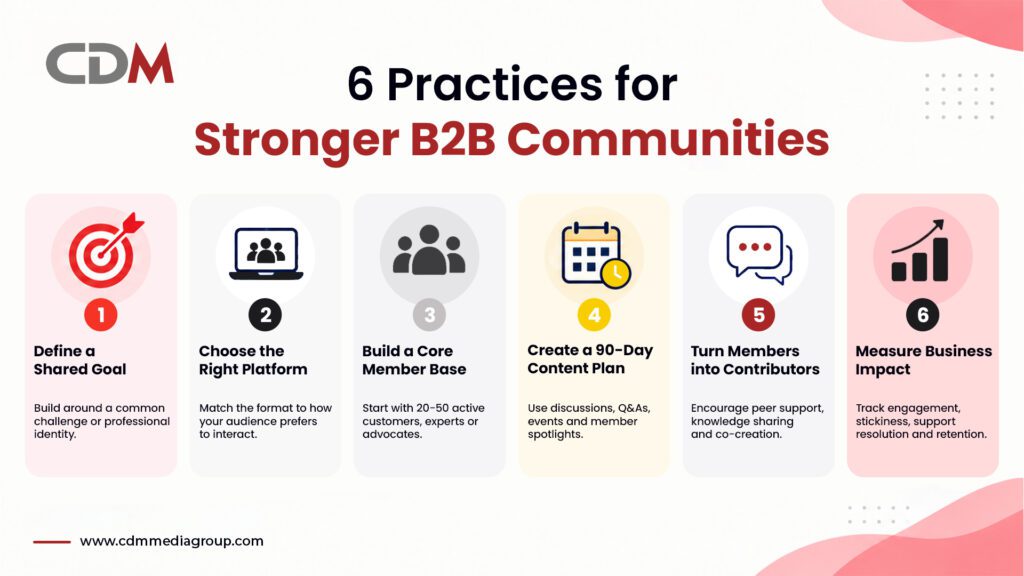
1. Know who it’s for:
Before picking a platform, answer three questions: Who is this community for? What problem or goal do they share? Why would they pick your community over others?
Build the community around a shared identity (“I’m a RevOps leader”) or a shared goal (“growing my SaaS from $1M to $10M”). Not around your product.
B2B SaaS example: A marketing automation company could create a community for marketing operations managers who want to improve campaign attribution and lead scoring. Members could discuss CRM integrations, reporting problems, and campaign workflows, even when the conversation isn’t directly about the company’s software.
2. Pick the right format
| Format | Platform | Best For |
| Real-time chat | Slack, Discord | Technical audiences |
| Discussion forum | Circle, Discourse | Deep knowledge sharing |
| Professional network | LinkedIn Groups | Building awareness and authority |
| Events | Luma, in person | Executives and networking |
| Learning community | Teachable + community | Courses and certifications |
The platform should make participation easier. For example, if users repeatedly ask the same integration questions, a searchable forum may be more useful than a fast-moving chat where answers quickly disappear.
3. Start small before you launch
Invite 20 to 50 founding members first, your best customers, experts, or fans. Let them talk privately for a few weeks so real conversations build up. When new members join later, they’ll see an active, useful space instead of an empty one. These early members also become your first advocates.
B2B SaaS example: A project management software company could invite experienced project managers to share their sprint planning templates, discuss resource allocation problems, and suggest ways to manage cross-functional projects. When new members join, they can immediately find useful discussions instead of an empty community.
4. Plan your content ahead of time
Set up a 90-day content plan with things like discussion topics, weekly questions, member spotlights, and expert Q&As. Treat this planning like you would for your marketing content, not as an afterthought.
B2B SaaS example: A customer support platform could organize a monthly discussion on reducing ticket resolution time, host a session on chatbot implementation, and invite a customer to explain how their team manages support escalations. Product tutorials can be included when they address a question members are already trying to solve.
5. Support your most active members
A small group of members usually creates most of the value. Find them early and reward them with things like early access, chances to co-create content, or speaking spots. When these “community champions” feel valued, they help the community grow on their own.
B2B SaaS example: A CRM company could invite experienced administrators to lead workflow workshops or review proposed product improvements. Their feedback helps the product team understand real-world needs, while other members benefit from practical guidance. Recognition should reward genuine contributions rather than simply the number of posts published.
Why community-led growth matters for customer retentions
Most community teams struggle with the same two things: keeping members engaged, and proving that engagement actually matters to the business. Here are the four metrics that show whether your community is actually helping retention:
1. Engagement Rate
What it is: The number of active members who are actively participating, not just signed up.
Formula: (Active members ÷ Total members) × 100
Why it matters: Members who show up and interact feel more connected to your brand, and connected members stick around.
2. Stickiness
What it is: How often people come back to the community.
Why it matters: Frequent visits usually mean the community is genuinely useful to them. The more value they get, the less likely they are to leave.
3. Content Contribution Rate
What it is: How much content members create, such as posts, comments, and shared resources.
Formula: Total user-generated content ÷ Total members
Why it matters: People who contribute aren’t just passive users; they’re invested. That investment translates to loyalty.
4. Community Support Resolution Rate
What it is: How many support questions get solved by peers in the community, instead of going to your official support team?
Formula: Issues solved in community ÷ Total issues raised
Why it matters: A strong resolution rate means your community is doing double duty as a support system, and quick, helpful answers keep people happy and around.
Final Thoughts
Community-led growth is about much more than creating a group and hoping people will engage. It’s about building genuine relationships, helping customers get more value from your product, and creating a space where they feel heard and supported. For B2B companies, a strong community can encourage deeper engagement, improve product adoption, build trust, and ultimately help keep customers connected to the brand for longer.
Want to build stronger connections with your B2B audience? CDM Media Group can help you create content and communication strategies that engage the right audience and build lasting brand relationships.
Contact Us Today!
FAQs
1. When should a B2B company invest in community-led growth?
Community-led growth makes sense when customers benefit from sharing knowledge, solving common problems, or learning from other users. For example, a SaaS company with complex onboarding may build a customer community where experienced users help new customers get started.
2. How can a company get customers to participate in its community?
Start with a clear reason to participate. Invite customers to discuss specific product challenges, exchange workflows, or attend expert-led sessions. Address unanswered questions promptly and involve experienced users who can share practical advice. Avoid relying on generic announcements to drive engagement.
3. How can businesses prove that a community contributes to revenue?
Track community engagement alongside business outcomes. For example, compare product adoption and renewal rates among engaged members and similar non-members. Track community-sourced referrals and opportunities that increase with community interactions. These comparisons can reveal useful patterns, although they do not prove causation on their own.
4. Who should manage a community-led growth program?
Ownership depends on the program’s goals. Customer success teams can focus on onboarding and product adoption, marketing can support advocacy and awareness, and product teams can use discussions to identify recurring user problems. A designated community manager can coordinate these efforts and track progress against shared goals.
5. What are the common mistakes companies make with community-led growth?
Common mistakes include launching a community without a clear purpose, measuring success only through member counts, leaving questions unanswered, and treating the space as another promotional channel. Businesses should focus on whether members solve real problems, learn from one another, and achieve better result through participation.