
According to the July 2026 Schema.org usage dataset, 5,545 Schema.org...
Read MoreCDM Media Group – Content as a Service Provider




How a Sportsman’s Mindset Shapes Business Growth
What can building a business learn from building an athlete?...
Read More

How to Build a LinkedIn Marketing Strategy That Generates High-Quality B2B Leads
A strong LinkedIn marketing strategy is necessary if you want...
Read More
The Ultimate List of AI Search Optimization Tools for 2026
Your brand’s reputation is now stored in a new algorithm...
Read More
The Shop Floor Does Not Build Buyer Preference
A manufacturing company can have excellent products, strong engineering capabilities,...
Read More
Topical Authority in 2026: Creating Content AI Models Trust
Over 96.55% of all pages in our index receive zero...
Read More
Winning in AI Search: How to Measure and Expand Your Visibility
The evolution of search is here. Users are shifting away...
Read More
How Retrieval-Augmented Generation Helps AI Search Engines Discover Content
To understand the latest advancements in generative AI, imagine a...
Read More
Founder-Led Growth to GTM: Building Repeatable Growth
For most startups, growth starts with the founder. Personal networks...
Read More
How to Structure Content So AI Models Can Understand and Cite It
How to Structure Content So AI Models Can Understand and...
Read More

According to the July 2026 Schema.org usage dataset, 5,545 Schema.org terms were being tracked, including 958 types and 4,587 properties. Also, 52 terms were used across more than 10 million domains, showing the adoption of structured data.
Structured data markup is translated by platforms such as Google and Microsoft to provide enhanced rich results (or rich snippets) in search engine results pages or emails.
Schema data is an independent project that has helped establish consistency in structured data on B2B websites across the internet. Schema.org was launched in 2011 through a collaboration between Google, Bing, and Yahoo, with Yandex joining later that year.
Structured data formats such as RDFa, Microdata, and JSON-LD can be used to apply the schema.org vocabulary to web pages. Google prefers the JSON-LD structured data because it is the simplest to use and maintain.
How Schema Markup Defines Content for Search Engines
Structured data code, known as schema markup, helps AI and search engines decipher the meaning of your content rather than just its words.
Schema.org, a universal vocabulary approved by all major search engines, was the answer. Schema markup can be compared to adding machine-readable name tags to your content.
The conversion of ‘strings,’ unstructured text that needs to be interpreted, into ‘things,’ explicitly defined entities with distinct properties, is the basic issue that schema resolves. By using key-value pairs, you give search engines direct answers rather than making them infer meaning through resource-intensive natural language processing.
Why B2B Websites Need Structured Data
There is still an opportunity for B2B websites to make better use of structured data. According to W3Techs data from June 2026, JSON-LD was used by 55.2% of websites, while microdata appeared on 21.6% and generic RDFa on 37.2%. While structured data isn’t a shortcut to higher rankings, well-implemented Schema.org markup can help search engines better understand a website’s content and make eligible pages more likely to appear in enhanced search results.
Higher click-through rates: Ahrefs analyzed Google Search Console data from more than 422,000 websites and found that AI Overview can reduce clicks to the top organic result by roughly 58%. This makes enhanced search visibility, including eligible rich results, increasingly important for websites competing for attention in search. When your listing shows FAQ answers, service details, or event information directly on the results page, more people click.
Improved search visibility: Schema markup for SEO modifies the appearance of your result, which drives more engagement; structured data does not directly improve organic rankings. It can, however, make eligible pages easier for search engines to interpret and may lead to improved search visibility. Also, B2B schema markup qualifies your content for AI overview citations and featured snippets, elevating you above the competition without requiring a top-three ranking.
AI platform visibility: Structured data can provide additional machine-readable context about entities and content on a website. That can help systems interpret the information, but schema markup should not be treated as a confirmed route into AI-generated search results.
Increased brand awareness: A B2B schema markup for SEO surfaces your social media profiles, contact information, and logo in search results. Schema powers knowledge panels, which are the brand information boxes on Google’s right side. Organized structured data can help search engines understand key information about a business, such as its name, logo, website, and relevant profiles.
A better experience before the click: The value of structured content goes beyond traditional search features. When B2B websites clearly answer common buyer questions and organize information in a way that search engines can understand, customers can learn more about a solution before contacting sales. By the time they reach out, they may already understand your offering, making sales conversations more focused and productive.
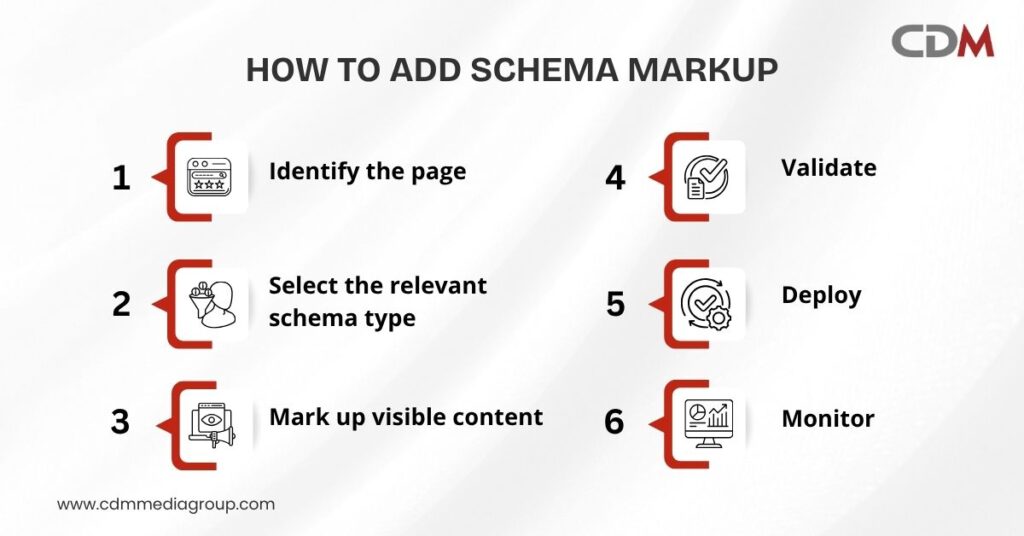
Implementing Schema Markup on a B2B Website
Here’s how to generate and add schema markup to your site:
1. Choose a schema type
Choose a schema type based on the page’s main purpose. Here are some of the most common page types and which schema type makes the most sense to use:
| Page type | Best-fit schema type |
| Homepage or about page | Organization |
| Blog post or news article | Article |
| Product page where users can buy directly | Product (merchant listing) |
| Product review page with no direct purchase option | Product (snippet), with Review or AggregateRating nested |
| Physical business location page | Local Business, or the most relevant specific subtype (e.g., Restaurant, Store) |
More schema isn’t automatically better. Don’t just mark up every possible entity on a page.
2. Generate your schema
Generate your schema markup for SEO manually.
How to generate schema markup manually
Generating schema markup manually gives you greater control over what you include, but it requires an understanding of JSON-LD syntax and the relevant Schema.org properties. You can add a <script type=”application/ld+json”> block to the page, typically in the <head> or <body>, and define the structured data using the appropriate Schema.org vocabulary.
This works well once you’re comfortable with the syntax. It’s also easy to scale since you can use the schema you generate as a template across similar pages.
3. Add the schema markup to your website
Once you have your schema markup code, add it to the relevant webpage. If you’re using JSON-LD, you can generally place the code in the HTML section.
If you generated the markup using a schema generator, copy the code and add it to the appropriate page. If you are using a WordPress SEO or schema plugin, it may automatically generate and add the structured data to your pages, depending on the plugin and schema type you’re using.
4. Validate the markup
Validate your structured data using Google’s Rich Results Test before publishing it. Enter the page URL or paste your JSON-LD markup to check whether it is valid and eligible for supported rich results.
If the test identifies errors, review the markup, make the necessary changes, and rerun the test.
Once the markup passes validation, publish it on the live page. Use Google Search Console to monitor implementation and identify structured data issues on your site.
Keep in mind that valid structured data does not guarantee that Google will display a rich result. It makes the page eligible for supported search features when the relevant requirements are met.

Final Thoughts
Schema markup is no longer just an SEO improvement; it’s a major part of making your B2B website more discoverable in both search engines and AI-powered search experiences. As search continues to evolve, schema markup gives your business a competitive advantage that’s too valuable to ignore.
Looking to implement schema markup for SEO the right way? CDM Media Group helps businesses optimize their websites through SEO, structured data, and technical SEO strategies that improve visibility, attract qualified leads, and support long-term digital growth. Contact our experts today to future-proof your website.
FAQs
1. Can I add schema markup manually?
Yes. You can create JSON-LD manually using the appropriate Schema.org vocabulary and properties. This gives you greater control but requires an understanding of the syntax and the information you’re marking up.
2. Does schema markup improve Google rankings?
Schema markup doesn’t directly improve rankings but can increase visibility and click-through rates through rich snippets.
3. Which schema format does Google recommend?
Google recommends using JSON-LD because it is the easiest format to implement and maintain.
4. Why is schema markup important for B2B websites?
It provides search engines with clearer, machine-readable information about the business, its content, and relevant entities.
5. Can schema markup help with AI search platforms?
Yes. Schema markup gives search engines a clearer context about your content and entities, which can support better understanding. However, it does not confirm visibility or citations in AI search results.