You’ve got a Slack workspace with 847 members. Your Discord...
Read More



International SEO Strategy: Common Mistakes SaaS Companies Should Avoid
A market research study projects that the global SEO market...
Read More

How to Create Sales Enablement Content for Every Stage of the B2B Buyer’s Journey
According to Gartner’s 2026 sales survey, 67% of B2B buyers...
Read More
How B2B Podcast Marketing Builds Authority and Drives Pipeline
Podcasting has become an increasingly important channel for brands looking...
Read More
How B2B Video Marketing Improves Brand Trust and Sales Conversions
Think about the last time you considered buying a B2B...
Read More
You Don’t Know You are Scaling Until the Questions Change
A founder asks, ‘Can we do it?’ A scaling company...
Read More
Schema Markup for SEO: Essential Structured Data Every B2B Website Needs
According to the July 2026 Schema.org usage dataset, 5,545 Schema.org...
Read More
How a Sportsman’s Mindset Shapes Business Growth
What can building a business learn from building an athlete?...
Read More
How to Build a LinkedIn Marketing Strategy That Generates High-Quality B2B Leads
A strong LinkedIn marketing strategy is necessary if you want...
Read More
The Ultimate List of AI Search Optimization Tools for 2026
Your brand’s reputation is now stored in a new algorithm...
Read More
Over 96.55% of all pages in our index receive zero traffic from Google, while only 1.94% get between one and ten monthly visits. It is not because it is poorly written. In many cases, it lacks the depth, structure, and authority that modern search engines look for.
Many brands still chase high-volume keywords and publish blogs, yet struggle to gain visibility. The issue is not the effort they put into SEO; it’s the strategy behind it.
So, here’s the real question: Are you simply creating content, or are you building authority?
Building complete authority around a topic is now important for SEO success. That’s why learning how to build topical authority has become one of the biggest competitive advantages in search.
What is topical authority in SEO?
Topical authority is your website’s ability to show deep expertise and complete coverage on a specific subject. Ranking comes from covering a complete ecosystem of related queries, rather than targeting a single keyword.
Search engines today evaluate:
- How well you cover a topic
- How your pages are interconnected
- Whether your content satisfies multiple stages of user intent
For example, instead of just writing ‘LinkedIn lead generation,’ a brand with authority will cover linkedIn outreach strategies, automation tools, messaging frameworks, case studies, compliance, and personalization.
This is where semantic SEO strategy comes into play: connecting meaning, not just matching keywords.
Challenges in Building Topical Authority
1. Random Content Publishing
Many brands still follow a keyword-first approach, publishing blogs based on trends or search volume without a structured plan.
2. Lack of Content Depth
Surface-level content is one of the biggest limitations. Blogs are mainly written to target a keyword, not to fully solve a problem.
Today, search engines favor content that covers a topic in depth, such as adding examples, frameworks, and research insights.
3. Weak Internal Linking
Even strong content fails without proper internal linking. If your pages are not connected logically, search engines cannot understand their relationship.
4. Over-Reliance on Backlinks
Backlinks still matter, but they are no longer enough on their own. Many sites focus heavily on link-building while ignoring content depth and relevance.
5. Ignoring Search Intent Layers
Most businesses target only primary keywords and ignore the broader user journey. They miss related queries such as comparisons, FAQs, and implementation guides.
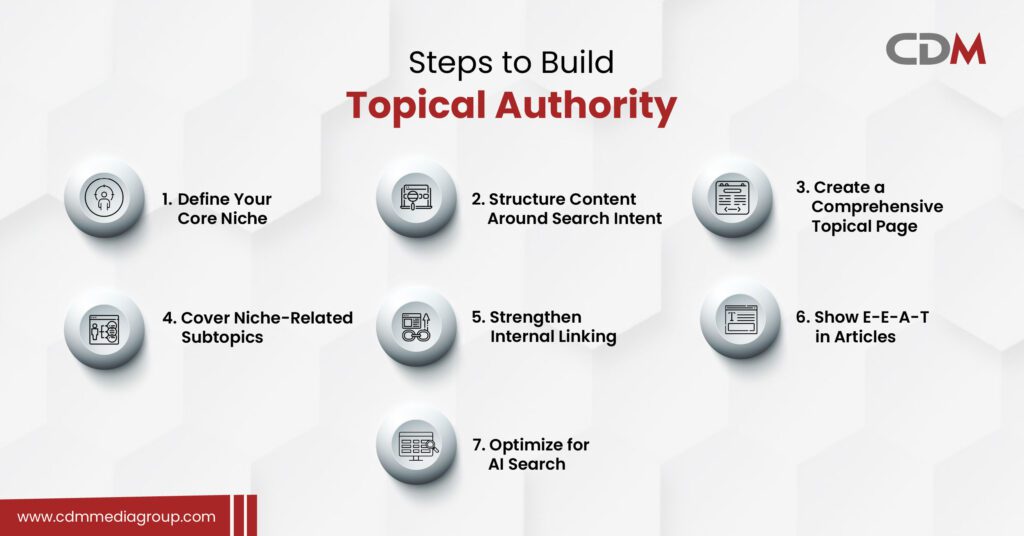
How to Build Topical Authority in 2026
Step 1: Define Your Topic as an Entity, Not a Keyword
The foundation of topical authority starts with how you define your topic.
In 2026, Google does not evaluate keywords in isolation; it evaluates entities and their relationships. This means your goal is not to pick a keyword but to define a semantic SEO boundary around a topic.
This semantic boundary helps Google understand:
- What your site is about
- What subtopics you own
- How your content connects
And this is critical for EEAT, because expertise is no longer judged page by page, and it is evaluated at the topic level across your domain.
Step 2: Structure Content Around Search Intent
Once your topic is defined, the next step is structuring your content not around keywords, but around search intent layers. In 2026, a content clusters strategy is not just grouping blogs. It is about building a topic graph that shows user intent across the funnel.
Every topic must be expanded across three layers:
- Informational: what it is, how it works
- Commercial: tools, comparisons, best practices
- Transactional: solutions, product-driven content
Step 3: Build a Pillar Page That Signals Authority
At the center of this structure sits your pillar page, but in 2026, a pillar is not just long-form content. It is a topical authority asset. To make a pillar page SEO effective, your pillar must show both coverage and credibility.
This means it should:
- Cover all primary and secondary entities within the topic
- Follow a structured hierarchy (clear H2/H3 aligned with intent layers)
- Act as an internal linking hub connecting all cluster pages
Step 4: Expand Topic Coverage with Semantic Depth
After content structure comes depth. This is where most strategies fall short; they expand content through keywords, not through meaning. A strong semantic SEO strategy requires you to cover:
- Co-occurring entities
- Contextual variations (similar to LSI but more advanced)
- Concept relationships aligned with AI search models
Step 5: Reinforce Everything Through Internal Linking Architecture
Once your content has structure and depth, it needs to be connected in a way that reinforces topical signals. Internal linking is no longer just navigation; it is a topic reinforcement system. When done correctly, it creates a topical signal graph, where:
- Pillar pages work as central nodes
- Cluster pages reinforce subtopics
- Related pages connect based on semantic relevance
Step 6: Strengthen EEAT with Real Experience Signals
Even with structure and depth, authority is incomplete without experience. In 2026, EEAT has evolved to prioritize first-hand experience signals, mainly in competitive niches such as SaaS, finance, and healthcare.
To strengthen this:
- Add real workflows (step-by-step processes)
- Include actual metrics (conversion rates and ROI improvements)
- Document failures and optimizations
Step 7: Align Content with AI Search Systems
Finally, your content must be optimized not just for ranking but for retrieval and extraction. AI search (Google AI Overviews, ChatGPT, and Perplexity) systems evaluate content based on the following:
To optimize for this:
- Use clear, structured sections
- Add definition blocks and summaries
- Use schema markup (FAQ, How-To, Article)
- Ensure business clarity and consistency
Because in AI search, visibility is not just about ranking; it is about being selected as a trusted source of answers.
Final Thoughts
Topical authority in 2026 is the foundation of sustainable AI content strategy. When your content is built as a structured, interconnected system backed by semantic SEO depth, EEAT signals, and AI-ready formatting, it becomes the source search engines trust.
Instead of chasing keywords, the real shift is toward owning entire topics and guiding users across their journey.
CDM Media Group helps businesses build AI-ready content ecosystems that improve search visibility and establish long-term authority across Google and AI search platforms.

FAQs
1.Is topical authority more important than backlinks?
Topical relevance and depth, particularly in informational and AI search results, are more important for many queries than backlinks.
2. How does internal linking support topical authority?
Internal links help search engines understand topic relationships and increase contextual relevance across related pages.
3. Does topical authority improve conversion rates?
It can. When users find complete, trustworthy information on your website, they are more likely to engage with your brand, subscribe, request a demo, or make a purchase, leading to higher conversion rates.
4. Does topical authority help Google rankings?
Yes, websites with strong topical authority often achieve higher rankings, better visibility, and more stable organic traffic.
5. Can topical authority improve AI search visibility?
Yes, authoritative websites are more likely to be referenced in AI-generated answers from platforms like ChatGPT, Perplexity, and Google AI Overviews.