
You’ve got a Slack workspace with 847 members. Your Discord...
Read More



International SEO Strategy: Common Mistakes SaaS Companies Should Avoid
A market research study projects that the global SEO market...
Read More

How to Create Sales Enablement Content for Every Stage of the B2B Buyer’s Journey
According to Gartner’s 2026 sales survey, 67% of B2B buyers...
Read More
How B2B Podcast Marketing Builds Authority and Drives Pipeline
Podcasting has become an increasingly important channel for brands looking...
Read More
How B2B Video Marketing Improves Brand Trust and Sales Conversions
Think about the last time you considered buying a B2B...
Read More
You Don’t Know You are Scaling Until the Questions Change
A founder asks, ‘Can we do it?’ A scaling company...
Read More
Schema Markup for SEO: Essential Structured Data Every B2B Website Needs
According to the July 2026 Schema.org usage dataset, 5,545 Schema.org...
Read More
How a Sportsman’s Mindset Shapes Business Growth
What can building a business learn from building an athlete?...
Read More
How to Build a LinkedIn Marketing Strategy That Generates High-Quality B2B Leads
A strong LinkedIn marketing strategy is necessary if you want...
Read More
The Ultimate List of AI Search Optimization Tools for 2026
Your brand’s reputation is now stored in a new algorithm...
Read More
Have you noticed how Google can answer your complex, specific queries when you search? In most cases, thanks to featured snippets and AI overviews. And when you want to dig deeper with follow-up questions, tools such as ChatGPT, Gemini, and Meta AI are ready to step in, with more emerging every day.
For everyday users, this means research has never been easier. But for SEO professionals, the story is far more demanding; they work relentlessly behind the scenes to get content ranked for the very queries you type into Google.
The rise of content discovery in AI search is introducing fresh challenges to the world of content optimization for AI answers, making an already complex field even more intricate.
This practice focuses on structuring website content to deliver clear, direct answers to user queries, increasing the likelihood of being featured in SERP elements such as ‘People Also Ask boxes’, rich snippets, and similar placements. We will break down the core concept of Answer Engine Optimization and explore practical ways to implement it effectively.
What is an Answer Engine?
Answer engines are AI-powered technologies that leverage natural language processing to deliver precise, direct responses to user queries. Rather than presenting a list of search results to browse through, an answer engine cuts straight to the point, whether you’re searching for a recipe, seeking a specific fact, or checking the weather.
Where Are Answer Engines Used?
Answer engines power a variety of everyday digital experiences. Voice assistants such as Siri, Google Assistant, and Alexa rely on them to retrieve and deliver spoken responses to user questions. On search engines, features like top-ranking rich snippets and AI overviews use answer engine technology to pull data and generate concise, relevant summaries directly on the results page.
Types of Answer Engines
Understanding what type of content AI answer engines prefer is key to knowing how to optimize your content for each:
- Voice-Based Answer Engines: These power voice assistants and smart speakers that respond to spoken queries with direct, conversational answers.
- Search Engine Answer Features: These surface instant answers directly on the search results page, eliminating the need to click through to a website.
- Chatbot Answer Engines: These drive conversational AI interfaces, engaging users through back-and-forth dialogue to understand and respond to complex queries.
Best Practices for Answer Engine Optimization
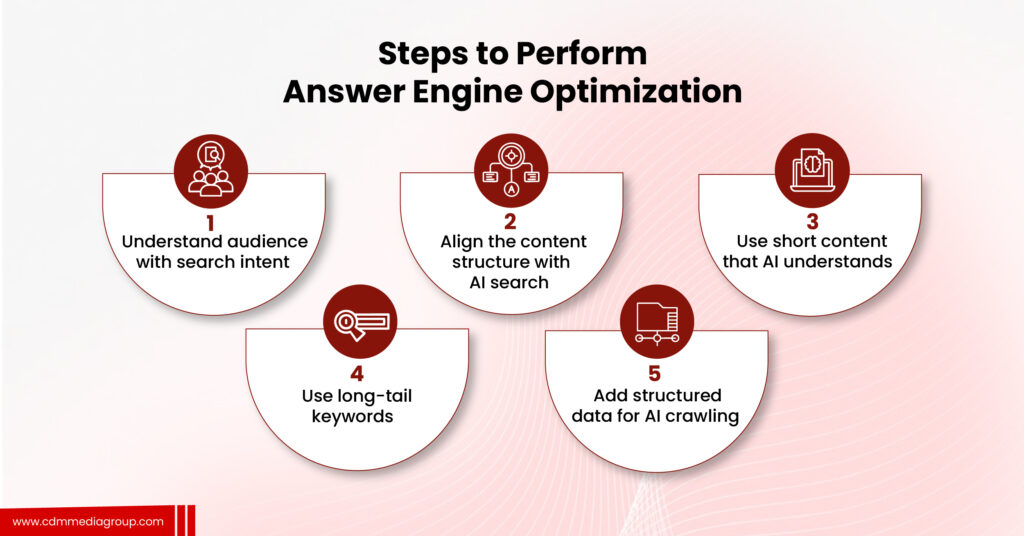
To practice AEO content optimization, focus on curating content that is easy to read and crawl for AI assistants. You can consider looking at what people usually search on AI bots or ask voice assistants.
Understand the User’s Intent
User intent, also known as search intent, is the primary motive behind the queries users make on the internet. Is it really well known that there are four main types of search intent:
- Informational, where the user is looking for information related to any topic, and they intend to learn something.
- Transactional, where users are looking to buy something.
- Navigational, where the user is looking for certain types of pages or websites.
- Commercial, where the user is researching products or services. Here, users might want to buy something but need to do some research to make a final decision.
To offer relevant and useful content optimization for AI answers, you should focus on understanding the intent of the search query. Tools like Google Keyword Planner and Ubersuggest can help you learn the intent behind the keywords that you are targeting. Once you know which search terms your website ranks for, you can dive deeper into the research to learn about the popular related terms, FAQs, etc.
Let’s understand this with an example. Suppose your keyword is ‘Tips to Rank on AI Search.’ With this, it’s clear that the user is searching for tips. If you clearly set out the steps in your content simply and straightforwardly, content optimization for AI answers.
Be Straightforward and Concise
You want to make sure your website’s content is up to the mark and answers all the questions your audience might have. That’s a great goal to start with! To achieve this, focus on providing high-quality, concise answers. You don’t need to beat around the bush or give unnecessary information.
Make sure your answers are accurate, up to date, and relevant to your audience’s needs. And don’t forget to keep it concise! This will help you appear in the featured snippet (the first organic result in organic searches).
There is one more important thing to note. With voice search on the rise, it’s more important than ever to provide concise, accurate answers. So, make sure you optimize your content for voice assistants like Siri, Alexa, and the Google Assistant.
Use Long Tail Keywords
In AEO, long-tail keywords play a crucial role in helping you provide specific answers to users’ questions. When you incorporate these keywords into your content, you can increase the likelihood that your answer will be selected as the best response. This is because long-tail keywords are specific phrases or questions that users ask when searching for answers. These keywords are often more detailed (highly specific) and less competitive than generic keywords.
For example, if you’re creating content about AEO, a generic keyword would be ‘AEO.’ However, a long-tail keyword would be “What type of content do AI answer engines prefer?” By incorporating this long-tail keyword into your content, you can provide a more accurate, relevant answer to users searching for that specific information.
Using long-tail keywords in AEO content optimization can have several benefits. Firstly, it allows you to provide more accurate answers to users’ questions. By incorporating specific keywords, you can provide more relevant, detailed information that better meets the user’s needs. Secondly, long-tail keywords can increase the visibility of answers. By optimizing your content for specific keywords, you can increase the likelihood that your answer appears when those keywords are searched for.
Finally, using long-tail keywords in AEO content optimization can improve user satisfaction. You can increase the chances of your answer being used by providing accurate and relevant answers.
Structured Data
Structured data and markup play a crucial role in helping search engines understand the context and relevance of your content. Adding metadata to your content helps search engines understand it better and match it to user queries.
By using structured data and markup, you are helping search engines in several ways. Firstly, entity recognition enables it to identify specific entities, such as names, locations, and organizations. It helps the answer engine understand the context of your content.
This is basically about defining relationships between entities, which also helps search engines better understand how your content fits into the broader knowledge graph.

Start optimizing content for AI answers
Content discovery in AI search is no longer just about rankings; it’s about becoming a trusted source of answers. As search evolves with AI, the brands that win are those consistently recognized for delivering clear, credible, and immediate value.
With AI transforming how users discover information, AEO content optmization has become essential. Unsure where your brand stands? Begin by optimizing content for AI answers. At CDM Media Group, we help you assess your current position, identify visibility gaps, and create a tailored roadmap for success in AI-driven search.