
You’ve got a Slack workspace with 847 members. Your Discord...
Read More



International SEO Strategy: Common Mistakes SaaS Companies Should Avoid
A market research study projects that the global SEO market...
Read More

How to Create Sales Enablement Content for Every Stage of the B2B Buyer’s Journey
According to Gartner’s 2026 sales survey, 67% of B2B buyers...
Read More
How B2B Podcast Marketing Builds Authority and Drives Pipeline
Podcasting has become an increasingly important channel for brands looking...
Read More
How B2B Video Marketing Improves Brand Trust and Sales Conversions
Think about the last time you considered buying a B2B...
Read More
You Don’t Know You are Scaling Until the Questions Change
A founder asks, ‘Can we do it?’ A scaling company...
Read More
Schema Markup for SEO: Essential Structured Data Every B2B Website Needs
According to the July 2026 Schema.org usage dataset, 5,545 Schema.org...
Read More
How a Sportsman’s Mindset Shapes Business Growth
What can building a business learn from building an athlete?...
Read More
How to Build a LinkedIn Marketing Strategy That Generates High-Quality B2B Leads
A strong LinkedIn marketing strategy is necessary if you want...
Read More
The Ultimate List of AI Search Optimization Tools for 2026
Your brand’s reputation is now stored in a new algorithm...
Read More
Google’s structured content for search engines has fundamentally shifted how users discover and engage with information online. Rather than sifting through pages of links, users now receive instant, synthesized answers drawn from multiple trusted sources and delivered in clear, conversational summaries.
According to Google, you should be able to qualify for inclusion in AI Overviews just by following its Search Essentials guidance. However, some specific tactics could help your website get featured answers optimization.
To structure content for AI-featured answers, use an “answer-first” approach: place concise (1–3 sentence) summaries directly under clear, question-based H2/H3 headings. Use bullet points, tables, and FAQ sections to improve clarity and ensure each answer is self-contained. Over 75% of cited content uses high-level, structured takeaways.
What we mean by “AI search.”
AI, or artificial intelligence, is an incredibly broad term. In the context of AI search engine optimization, when we talk about AI, we mean a type of generative AI called a large language model (LLM). LLMs include those AI programs most of us are familiar with, such as ChatGPT and Gemini. These programs work specifically with text or language, hence the name.
But what does that mean, exactly?
Think of the last time you used an LLM, such as ChatGPT or Gemini. Let’s say you asked, “What are the five important concepts of SEO?” The program has been trained to comb through mountains of text (language) and recognize patterns in relation to your query. It can ‘understand’ your objective of the five important concepts of SEO and draw on its ‘knowledge’ of words, phrases, and patterns of communication to help you achieve it.
In this case, it will rapidly “predict” the five key SEO concepts and the instructions for each. And because we’ve figured out how to make LLMs very effective, the result will probably be important!
Search engine AI exhibits the same behavior when generating AI overviews in the SERPs. Google AI can quickly process your question, then scan the web and provide a response by analyzing and predicting language patterns.
This aligns with Google’s long-stated goal of prioritizing users’ needs. Now, a user doesn’t have to comb through a handful of search engine results, because there’s a reliable summary right at the top of the SERP.
How Featured answers optimization Work In AI Search Engine
AI Overviews and AI Mode surface relevant links to help people find the information they are looking for quickly and reliably and to help them explore content they may not have discovered before. These features offer unique opportunities for more types of sites to appear.
AI overviews help individuals quickly grasp the essence of a complex topic or question, serving as a starting point for further exploration of links to additional information. They were designed to show up on queries where they can add additional benefits beyond what people might already get on Search.
AI Mode is particularly helpful for queries that require further exploration, reasoning, or complex comparisons. People can ask nuanced questions that might have previously taken multiple searches, from exploring a new concept to comparing options and beyond, and get a comprehensive AI-powered response with links to supporting websites.
Both AI Overviews and AI Mode may use a “query fan-out” technique, issuing multiple related searches across subtopics and data sources to develop a response. As the answers are generated, our sophisticated models actively identify additional valuable web pages. This allows for a more diverse and
comprehensive selection of informative links related to the answer than a standard web search, thus creating new chances for deeper exploration.
How to Optimize Content for Featured Snippets & AI Search
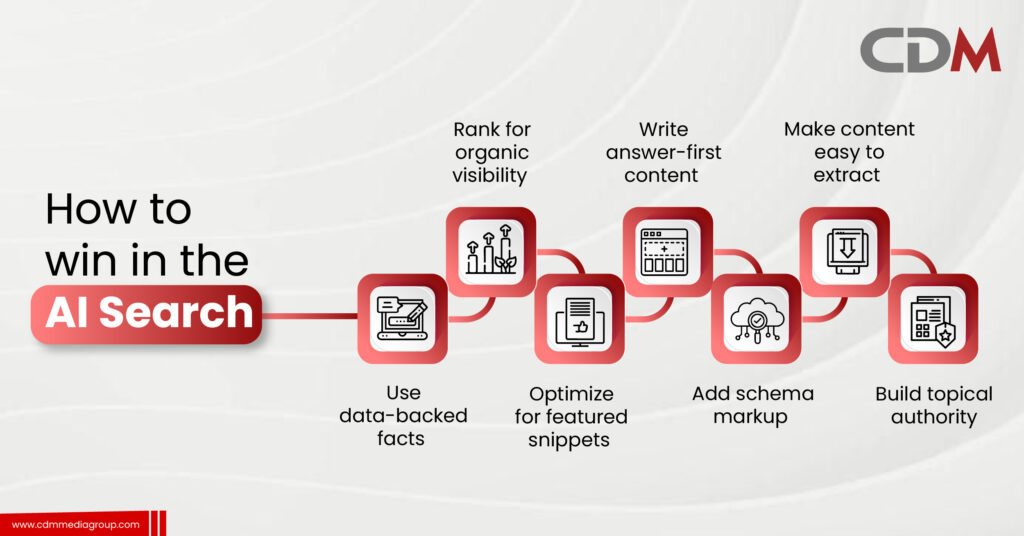
- Put the answer first, then explain it: The first 200 words of any article should directly and completely answer the primary query, not build up to the answer. This mirrors the TL;DR (too long; didn’t read) first structure that top-performing AI content consistently uses.
- Write passages that stand alone: Passages that retain meaning when read in isolation are more likely to be retrieved and used accurately. Passages that rely on conversational setup or references like “as mentioned above” or “this approach is why” tend to lose clarity when extracted. Every paragraph should make sense without the ones around it.
- Make content snippable and heading-aligned: If you want to be cited, you need a snippable, machine-digestible portion of text that’s relevant to a heading. Think of each heading + its paragraph as a self-contained unit of information.
- Use FAQs, lists, and tables: Structure for extraction: use FAQs, lists, and tables that align with how engines present information. Write in plain, parseable language that doesn’t require AI translation.
- Pack in data and cite your sources: Maintain a high fact density, using statistics every 150–200 words, and cite authoritative sources throughout. Data-backed claims are far more likely to be pulled than general assertions.
- Add schema markup: Implement FAQ, How-To, and Article schema consistently. Single Grain content with proper schema markup shows 30–40% higher AI visibility.
- Keep information current: Add a ‘What changed in [current year]’ section to perennial articles. This signals freshness to both AI systems and human readers.
- Write something unique: If your content is 75% similar to your competitors’ but has 25% new content, the AI is more likely to cite it due to the information gain. Proprietary data, original frameworks, or fresh insights give AI a reason to pick you over similar sources.
What Helps Content Appear in Google AI Overviews
- Strong organic rankings: A significant majority (76.1%) of the citations appearing in the AI Overview are also found within the top ten results on a standard Google
- search. Your traditional SEO foundation is still the single biggest lever. Schema markup is one of the elements used for generating AI overviews. Implement the FAQ, how-to, and article schema consistently.
- Extractable, self-contained passages: When passages can be understood independently, they are more likely to be accurately retrieved and utilized. Passages that rely on conversational setups or references such as “as mentioned above” or ‘this is why’ tend to lose clarity when extracted.
- Answering the query immediately: To allow AI to easily extract featured snippets, ensure the first paragraph of your article directly and thoroughly addresses the main query, rather than introducing or delaying the answer.
- Fresh, updated content: Articles with visible ‘Last Updated’ signals, current statistics, and fresh examples outperform evergreen content for fast-moving topics.
- Fact density and cited sources: Continue using statistics and citing reliable sources at all times.
- Third-party credibility signals: When multiple independent sources discuss your brand in relevant contexts, AI systems have clearer signals to interpret your credibility.
- Technical basics: HTTPS, Core Web Vitals performance, and mobile optimization are baseline requirements.

Ready to transform your structured content for search engines?
Your content strategy needs to develop as fast as technology. At CDM Media Group, experts build AI Overviews content architectures designed specifically for enterprises to appear in AI Overviews. Content formatting for AI search helps improve your visibility on platforms like ChatGPT and Google Overview. Restructures your content for search engines and optimizes it for AI searches. Don’t let your competitors get cited first.