
You’ve got a Slack workspace with 847 members. Your Discord...
Read More



International SEO Strategy: Common Mistakes SaaS Companies Should Avoid
A market research study projects that the global SEO market...
Read More

How to Create Sales Enablement Content for Every Stage of the B2B Buyer’s Journey
According to Gartner’s 2026 sales survey, 67% of B2B buyers...
Read More
How B2B Podcast Marketing Builds Authority and Drives Pipeline
Podcasting has become an increasingly important channel for brands looking...
Read More
How B2B Video Marketing Improves Brand Trust and Sales Conversions
Think about the last time you considered buying a B2B...
Read More
You Don’t Know You are Scaling Until the Questions Change
A founder asks, ‘Can we do it?’ A scaling company...
Read More
Schema Markup for SEO: Essential Structured Data Every B2B Website Needs
According to the July 2026 Schema.org usage dataset, 5,545 Schema.org...
Read More
How a Sportsman’s Mindset Shapes Business Growth
What can building a business learn from building an athlete?...
Read More
How to Build a LinkedIn Marketing Strategy That Generates High-Quality B2B Leads
A strong LinkedIn marketing strategy is necessary if you want...
Read More
The Ultimate List of AI Search Optimization Tools for 2026
Your brand’s reputation is now stored in a new algorithm...
Read More
A recent study by the management consultancy McKinsey estimates that generative AI search could add as much as USD 4.4 trillion to the global economy annually. Search results directly provide quick, direct responses to user queries through AI answers and featured snippets.
Featured snippets usually appear as a short paragraph, list, or table taken from a webpage. Newer AI-generated answers and overviews summarize information from multiple sources to present a clear response.
The page structure is crucial because these systems extract specific sections of content. Pages that use clear headings, logical sections, and concise explanations make it easier for search engines and AI assistants to understand the content and identify the most relevant answers. User-readability improves with well-structured content, increasing the likelihood that key information surfaces directly in search results.
What is the AI Overview in Google Search
AI overviews are AI-generated answers that appear at the top of the Google Search Engine Results Page (SERP). Google’s large language models analyze information from relevant sources to generate responses directly on the search engine results page.
Google also includes a list of resources for generating answers. Users can check them through website links.
However, these AI answers, combined with other SERP features, increase the likelihood of zero-click searches, as users can find answers without visiting specific websites.
How AI Search Extracts Answers
Search engines and AI models look for content that directly answers a specific question. Clearly defined sections in the information make it easier for these systems to identify the most relevant response on the page.
Content that introduces a topic clearly and then expands on it with supporting information is more likely to be recognized as a strong source of answers. This is particularly important as search engines increasingly generate summaries using information from multiple pages.
Therefore, pages with a clear structural interpretation are more likely to serve as trusted references.
How should marketing teams practically optimize for AI search?
Structuring Content for Featured Snippets
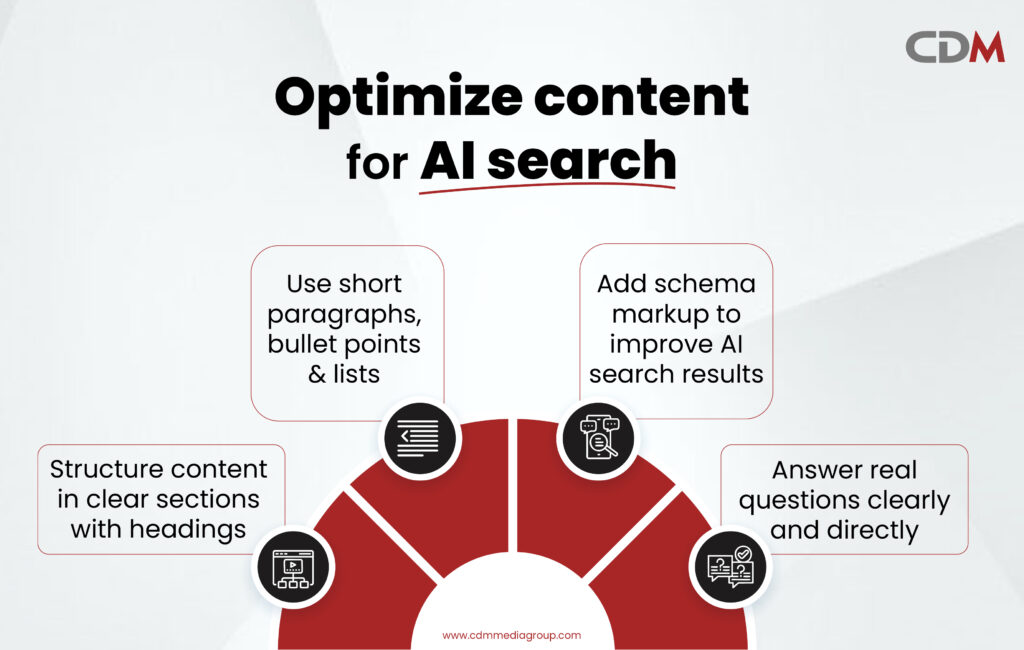
Featured snippets typically pull short sections of content that clearly answer a question. One effective approach is to use headings that reflect common search queries, followed by a concise answer near the beginning of the section. This allows both users and search engines to quickly identify key information.
Formatting also plays an important role in marketing optimization for AI search. Lists, tables, and short paragraphs break information into smaller sections that are easier to scan and extract.
Content formats that often perform well for snippets include the following:
- Definition-style explanations
- Step-by-step instructions
- Comparison matrix
- Bullet point summaries
These formats make it easier for search engines to isolate the most useful part of the content.
Optimizing Content for AI Overviews and LLM Retrieval
AI-powered answers often rely on content that explains ideas clearly and provides enough context to stand alone in a summary.
Definition-style paragraphs are particularly effective because they introduce a concept and explain it concisely. Supporting context around key ideas also helps ensure the information remains meaningful when extracted into an AI-generated answer.
Mentioning related topics and terminology within the content can further help search engines understand the broader subject and how different ideas connect.
Well-organized sections, clear explanations, and natural language all improve the likelihood that AI systems can reference content.
The Role of Structured Data and Schema Markup
While structured writing helps search engines understand content, Schema markup provides additional machine-readable context.
A schema is a structured data format that helps search engines interpret what specific pieces of content represent. For example, a schema can identify:
- FAQs
- How-to instructions
- Products
- Reviews
- Articles
Adding schema markup doesn’t guarantee a featured snippet or an AI citation, but it can help search engines better understand the page’s structure and purpose.
Common schema types that support answer-led content include:
- FAQ Schema: highlights question and answer pairs
- HowTo Schema: structures step-by-step guides
- Article Schema: clarifies page type and authorship
- Product or Review Schema: adds structured commercial information
When combined with a clear content structure, schema markup strengthens the signals search engines use to interpret and surface information.
Technical and Formatting Best Practices
A clear page structure helps search engines and AI systems interpret how information is organized. Using a logical heading hierarchy, with an H1 for the page title and H2 or H3 tags for supporting sections, makes the content easier to follow and process.
Other helpful practices include:
- Keeping paragraphs concise
- Using lists and bullet points where appropriate
- Linking to related internal pages
- Ensuring content is easy to scan
Internal links are particularly valuable because they provide additional context and help search engines understand relationships between topics across the site.
Content Strategies That Improve Snippet Eligibility
Content is more likely to appear in featured snippets or AI answers when it directly addresses specific user questions.
Targeting long-tail keywords that reflect real search queries can help align pages with the way people naturally search.
Other useful strategies include:
- Adding FAQ sections that address common questions
- Creating comparison concepts or quick summaries
- Writing clear step-by-step guides
- Keeping information accurate and regularly updated
These formats make it easier for search engines to identify and extract useful answers.
What Not to Do: Frequent Missteps to Watch Out For
Some common issues can reduce the likelihood that content will appear in featured snippets or AI-generated answers. One of the most common problems is burying the actual answer within long paragraphs, making it harder for both readers and search engines to quickly identify the key point.
Unclear headings can also cause issues by making it challenging to grasp each section’s topic. Similarly, unclear explanations that don’t directly address the user’s question reduce the expectation that the content will be selected as a clear answer.
Poor page structure is another common issue to address when optimizing content for AI summaries. Search engines may struggle to identify the most relevant information on a page when its organization is illogical. Search engines prioritize pages that clearly address the user’s search intent, so content that doesn’t align with it can also limit visibility.
Ensuring the main answer is clear, concise, and easy to find significantly improves the likelihood that the content will be surfaced in search results.

Get Your Visibility With Marketing optimization for AI search
As search evolves, content structure is becoming as important as the information itself.
AI answers and featured snippets prioritize clear, direct responses. Pages that organize information into logical sections, provide concise answers, and support them with structured formatting are far easier for search engines to interpret.
This structure also enhances the reader’s experience with marketing optimization for AI search. Content that is easy to scan and clearly organized helps users find the information they need quickly.
CDM Media Group focuses on real questions, uses a strong structure, and supports content with SEO where appropriate; pages are far more likely to be optimized for AI summaries and AI search.
FAQs:
What is the difference between featured snippets and AI overviews in Google Search?
Featured snippets usually display a direct answer from a single webpage, while AI overviews summarize answers from multiple sources across the web.
How can marketers optimize content for AI-generated search results?
Marketing teams can optimize content by using clear headings, concise answers, bullet points, schema markup, and structured sections that directly address user questions.
Why is page structure important for AI search optimization?
A well-organized page structure helps search engines and AI systems better understand content, making it easier to extract relevant answers for snippets and AI summaries.
What types of content perform best for featured snippets?
Definition-style explanations, step-by-step guides, comparison tables, and bullet-point summaries often perform well because they present information in a clear and easy-to-extract format.
Does schema markup help improve AI search visibility?
Yes, schema markup provides machine-readable context that helps search engines better understand content types such as FAQs, how-to guides, reviews, and articles, improving the chances of appearing in AI-powered results.