
Think about the last time you considered buying a B2B...
Read More




You Don’t Know You are Scaling Until the Questions Change
A founder asks, ‘Can we do it?’ A scaling company...
Read More

Schema Markup for SEO: Essential Structured Data Every B2B Website Needs
According to the July 2026 Schema.org usage dataset, 5,545 Schema.org...
Read More
How a Sportsman’s Mindset Shapes Business Growth
What can building a business learn from building an athlete?...
Read More
How to Build a LinkedIn Marketing Strategy That Generates High-Quality B2B Leads
A strong LinkedIn marketing strategy is necessary if you want...
Read More
The Ultimate List of AI Search Optimization Tools for 2026
Your brand’s reputation is now stored in a new algorithm...
Read More
The Shop Floor Does Not Build Buyer Preference
A manufacturing company can have excellent products, strong engineering capabilities,...
Read More
Topical Authority in 2026: Creating Content AI Models Trust
Over 96.55% of all pages in our index receive zero...
Read More
Winning in AI Search: How to Measure and Expand Your Visibility
The evolution of search is here. Users are shifting away...
Read More
How Retrieval-Augmented Generation Helps AI Search Engines Discover Content
To understand the latest advancements in generative AI, imagine a...
Read More
Think about the last time you considered buying a B2B product or service. You probably didn’t start by calling a salesperson. You searched online, visited a few websites, watched a demo, looked for customer stories, and tried to understand whether the solution was actually worth considering.
That is how many B2B buying journeys begin today. Buyers are doing more research on their own, often long before they speak to a sales team. By the time that conversation happens, they may already have formed an opinion about your brand, your product, and the problem you claim to solve.
So how do you build trust when your sales team isn’t part of those early conversations?
This is where video can play a valuable role. It can show a product in action, simplify complex ideas, and give buyers a clearer picture of what your solution can actually do. With 91% of businesses now using video, the opportunity for B2B brands lies in using it to build trust early and help buyers move closer to a decision.
B2B Video Marketing Explained
In B2B, video isn’t just marketing; it’s proof. It shows prospects exactly how your product works and why it’s worth their trust. B2B video marketing supports a buying journey shaped by multiple stakeholders, helping each one reach the same answer at their own stage of research. These videos aren’t about a hard sell. They walk through a real problem, show how the product actually solves it, and give buyers a reason to trust the brand before a sales call even happens. Done well, it builds relationships and moves deals forward, not just views.
For example, Salesforce has built a library of video testimonials sorted by industry and outcome, so a healthcare customer might talk about a 300%+ ROI, while a finance team focuses on operational gains. A healthcare prospect will trust a story from another healthcare company far more than a generic product testimonial. Seeing a similar organization go through the same challenges makes the proof feel real, not rehearsed.
Video Formats That Work for B2B Brands
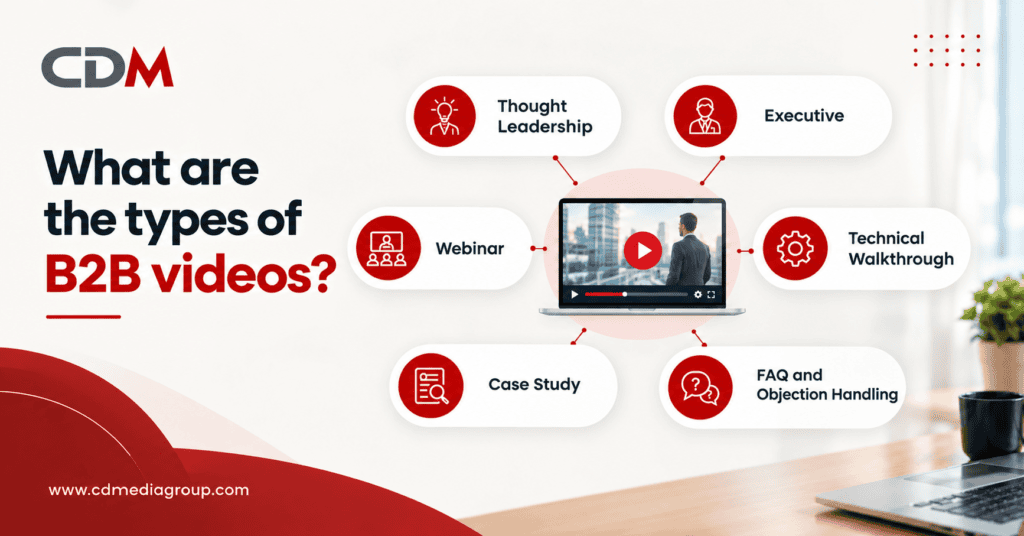
- Thought Leadership Videos: Share your team’s perspective on industry trends and challenges, positioning your brand as a source buyers can turn to before they’re even ready to buy.
- Executive Videos: Put leadership on camera to speak directly to prospects, adding a layer of credibility and accountability that a brand voice alone can’t provide.
- Webinars: Longer-form sessions that let you go deep on a topic, answer questions live, and build a more direct relationship with prospects further along the funnel.
- Technical Walkthroughs: Show, step by step, how a product actually works under the hood, helping technical buyers evaluate fit without needing a live demo.
- Case Study Videos: Walk through a specific customer’s problem, solution, and outcome in detail, giving prospects a realistic picture of what working with you actually looks like.
- FAQ and Objection-Handling Videos: Address the specific questions and hesitations prospects raise before signing, clearing up issues that would otherwise cause problems.
B2B Video Marketing Impact on Sales
Written content hasn’t gone anywhere in B2B research, but video has earned a place alongside it in how buyers evaluate their options; now they’re watching. B2B buyers are looking for easy-to-understand videos, making video marketing an important part of effective communication strategies.
Video speeds up the sales process by doing some of the selling before sales even get involved. A prospect who’s already watched a demo shows up to that first call with real questions, not basic ones, so reps spend less time explaining and more time closing.
It also helps when a deal involves more than one person. A champion inside the company can just forward a case study video to their team instead of setting up another meeting, so the deal keeps moving even when not everyone’s in the room.
And a two-minute video can clear up an objection that would otherwise turn into a week of email back-and-forth.
Building Industry Authority
Video lets buyers see proof of expertise, not just claims of it, through founder walkthroughs, product demos, and customer testimonials.
In fact, 93% of buyers view B2B video marketing as important for overall strategy. According to Wyzowl, 93% of respondents say video has helped them increase brand awareness.
Creating Trust Through Video
- Live webinars and social videos put you face-to-face with decision-makers, even when you’re not in the room with them.
- Video podcasts let your team share what they know, turning individual voices into recognized industry experts.
- Customer testimonials show, in the customer’s own words, how your product actually solved a real problem.
- User-generated videos serve as social proof that builds on itself because they aren’t coming from the brand.
Generate qualified leads
Video does more than add to your content mix. When used strategically, it helps turn interest into real pipeline activity.
According to Wyzowl, 40% of video marketers quantify ROI through customer engagement and retention. Two use cases are as follows:
- Personalized outreach videos drive account-level engagement: one-to-one messages built for a specific prospect.
- Webinars work for education and lead capture, reaching a room full of prospects at once, live or on demand.
- Product demos support evaluation, letting prospects see exactly how the product works before committing time to a call.
- Case studies provide validation, showing proof that the product delivers for companies like theirs.
Whether the approach is inbound or outbound, video does the same core job: it pulls in leads, helps you tell which ones actually match your ideal customer profile, and keeps a steady pipeline flowing to your sales team.
Secure sales and conversions
Organic video, such as live events or product demos, can genuinely increase B2B sales on its own. But there’s no rule saying you have to stop there.
With video ads, you’re targeting people who already know your brand, not starting from zero. That’s usually what gets you to a sale faster than organic reach alone.

Final Thought
When a product or process is hard to put into words, video lets you show it rather than describe it, and when it’s centered on the right message, it delivers exactly what the target audience needs to know without losing them along the way.
Explainer videos are easy to make and easy to ignore. CDM Media Group specializes in B2B video marketing that turns complex products into something simple to understand and turn into qualified leads, not just impressions. When B2B video marketing is done well, it delivers the results businesses need and provides real benefits.
FAQs
1. What is the difference between B2B and B2C video marketing?
B2B video marketing targets business decision-makers and focuses on value, expertise, solutions, and long-term business outcomes.
2. Why do B2B buyers prefer video content?
Video makes complex information easier to understand and helps buyers quickly evaluate products, services, and solutions.
3. How do you measure the ROI of B2B video marketing?
The clearest way to measure ROI is to connect video performance to the pipeline, not just views. Track engagement metrics (watch time, click-through rate) alongside funnel metrics such as landing page visits, form fills, sales-qualified leads, and closed deals that can be traced back to a video touchpoint. The strongest ROI story isn’t ‘we got 10,000 views’; It’s ‘This video contributed to X qualified leads and $Y in closed revenue.’
4. How long should a B2B marketing video be?
The ideal length depends on the video’s purpose. Short videos work well for awareness, while demos, webinars, and case studies can be longer.
5. Which platforms are best for B2B video marketing?
LinkedIn, YouTube, company websites, and email are commonly used to reach B2B audiences at different stages of the buying journey.