
Think about the last time you considered buying a B2B...
Read More




You Don’t Know You are Scaling Until the Questions Change
A founder asks, ‘Can we do it?’ A scaling company...
Read More

Schema Markup for SEO: Essential Structured Data Every B2B Website Needs
According to the July 2026 Schema.org usage dataset, 5,545 Schema.org...
Read More
How a Sportsman’s Mindset Shapes Business Growth
What can building a business learn from building an athlete?...
Read More
How to Build a LinkedIn Marketing Strategy That Generates High-Quality B2B Leads
A strong LinkedIn marketing strategy is necessary if you want...
Read More
The Ultimate List of AI Search Optimization Tools for 2026
Your brand’s reputation is now stored in a new algorithm...
Read More
The Shop Floor Does Not Build Buyer Preference
A manufacturing company can have excellent products, strong engineering capabilities,...
Read More
Topical Authority in 2026: Creating Content AI Models Trust
Over 96.55% of all pages in our index receive zero...
Read More
Winning in AI Search: How to Measure and Expand Your Visibility
The evolution of search is here. Users are shifting away...
Read More
How Retrieval-Augmented Generation Helps AI Search Engines Discover Content
To understand the latest advancements in generative AI, imagine a...
Read More
For most of the past two decades, getting found online meant ranking on Google. That is still true, but it is no longer sufficient. A growing share of search behavior now bypasses the results page entirely: users ask ChatGPT, query Perplexity, or receive AI-generated summaries before they ever see a list of links. The question businesses face in 2026 is not whether to optimize for AI-driven discovery, but how to do it systematically alongside the SEO foundations they have already built. That requires understanding three distinct but interconnected disciplines: SEO, AEO, and GEO, and knowing where each one applies.
SEO, AEO & GEO: Defining the New Search Trinity
Let’s establish clear, working definitions for each discipline before exploring how they interrelate.
Search Engine Optimization (SEO)
SEO is the original discipline. It optimizes content for algorithmic ranking in traditional search engines like Google and Bing. The core levers are keyword targeting, backlink authority, technical site performance, on-page metadata, and user experience signals like Core Web Vitals. SEO gets your content ranked on a results page that a human then chooses to click.
Answer Engine Optimization (AEO)
AEO optimizes content to appear in featured snippets, voice assistant responses, and direct answer surfaces; places where the engine responds without necessarily sending the user anywhere. It focuses on structured Q&A formats, schema markup, concise direct-answer writing, and targeting position zero.
Generative Engine Optimization (GEO)
GEO optimizes content for citation, synthesis, and inclusion by large language models and AI-native search engines like ChatGPT, Perplexity, and Google’s AI Overviews. It focuses on content depth, brand entity clarity, semantic topic coverage, and building an authoritative presence that AI systems are trained to trust and reference.
In practice, AEO and GEO overlap significantly. Optimizing for Google’s AI Overviews, for instance, requires both structured data (AEO) and topical authority (GEO). The distinction is most useful as a planning framework: AEO wins answer surfaces in existing search interfaces, while GEO prepares you for AI-native environments where traditional rankings may not exist.
Comparison of SEO, AEO, and GEO for Digital Visibility
| Criteria | Traditional SEO | Answer Engine Optimization (AEO) | Generative Engine Optimization (GEO) |
| Primary Goal | Drive clicks and website traffic through high keyword rankings | Deliver concise, authoritative answers in zero-click search experiences | Improve visibility and citations in AI-generated conversations and chatbot responses |
| Query Format | Short, keyword-focused searches (“best CRM software”) | Conversational, question-based searches (“What is the easiest CRM for small teams? ”) | Multi-step prompts and contextual AI chat queries |
| Content Structure | Long-form blogs, pillar pages, and backlink-driven content | Short answer snippets, FAQs, bullet points, and structured schema markup | Modular content blocks, expert insights, comparisons, and AI-friendly narratives |
| Technical Signals | Crawlability, backlinks, site speed, meta tags | Structured data (FAQPage, HowTo), clean HTML, speakable schema | RAG-friendly markup, citation metadata, APIs, and knowledge graph integration |
| Success Metrics | Organic traffic, keyword rankings, CTR, backlinks | Featured snippets, zero-click impressions, People Also Ask visibility, voice search share | AI visibility score, AI citation frequency, conversational engagement, response inclusion rate |
| Core Tools | Google Search Console, SEMrush, Ahrefs, Moz | Google Rich Results Test, MarketMuse, Schema.org, Google Search Console | Profound, Daydream, AI citation monitoring tools, knowledge graph APIs |
What the Future of SEO, AEO, and GEO Looks Like Beyond 2026
In 2026, SEO and AI search are diverging into separate disciplines. While traditional SEO still targets human clicks and browsing, AI search optimization focuses on providing accessible, trustworthy data for systems that generate answers directly. This shift redefines how digital authority and success are measured, moving beyond simple website visits to prioritizing how information is utilized by AI.
The data from 2025 and early 2026 confirms what many predicted: AI-generated answer surfaces are measurably reducing organic click-through rates. According to Search Engine Land, tracking Google AI Overview rollouts found that top-ranked organic results saw CTR declines ranging from 30% to over 60%, depending on query type, with informational queries hit hardest. Traditional search volume has not collapsed, but its share of total information-seeking behavior is shrinking as users increasingly turn to ChatGPT, Perplexity, and native AI assistants for answers they previously Googled. Businesses should treat this not as a crisis but as a structural shift requiring a proportional reallocation of visibility investment.
The businesses that will thrive are the ones treating AI visibility as a first-class growth channel, not an afterthought. This means investing in content infrastructure built for both humans and AI systems, measurement systems that track citation share alongside organic rankings and technical foundations (schema, structured data, and entity management) that make your content easy for AI to parse and trust.
GEO is genuinely early-stage, but the analogy to SEO in 2005 understates one critical difference: the competitive landscape. Early SEO grew into a discipline largely without interference from the search engines themselves. GEO is being shaped simultaneously by Google, OpenAI, Perplexity, and Anthropic each with different citation logic, different content preferences, and different levels of transparency. That makes GEO both an opportunity and a moving target. Companies that invest now will build structural advantages, but they should do so with frameworks flexible enough to adapt as these platforms mature and standardize their approaches.
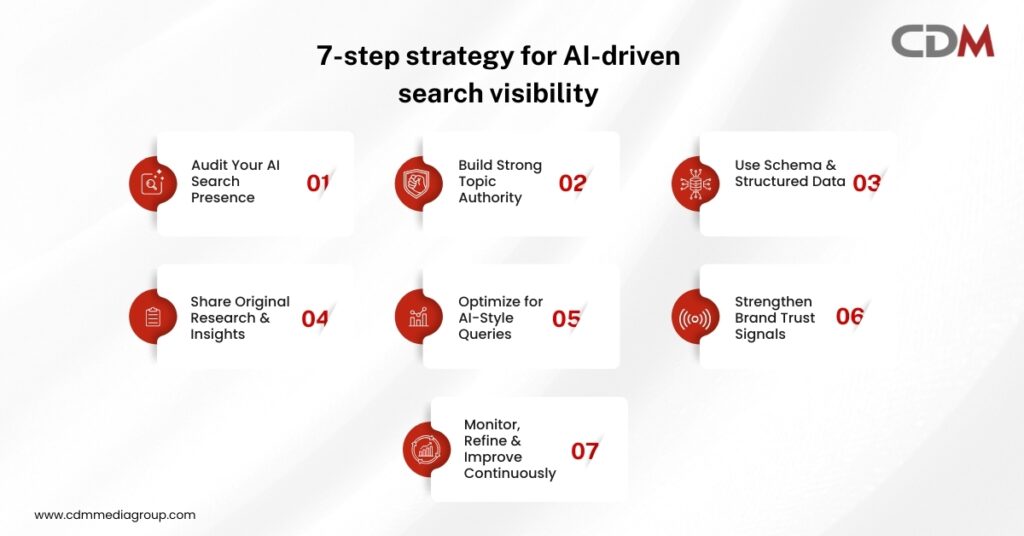
Building AI-Driven Search Visibility: A Unified 7-Step Strategy
- Audit Your Visibility
Analyze your presence across Google SERPs, AI Overviews, ChatGPT, Perplexity, featured snippets, and voice search to identify visibility gaps.
- Build Topical Authority
Create content clusters with pillar pages, supporting blogs, FAQs, and case studies to strengthen expertise and relevance.
- Use Structured Data
Implement schema markup like Article, FAQPage, Product, and Organization to help AI systems understand and cite your content.
- Publish Original Research
Develop surveys, reports, and data studies that encourage citations and improve the generative engine optimization (GEO) strategy.
- Optimize for Conversational Queries
Target natural language questions and create Q&A-style content for better answer engine optimization in 2026 performance.
- Strengthen Brand Entity Signals
Maintain consistent brand information across Wikipedia, Wikidata, Google Knowledge Panels, and trusted industry sources.
- Monitor and Improve Performance
Track AI mentions, citation share, AI-driven search visibility, and referral traffic to refine your strategy continuously.

Conclusion
The digital marketing world is entering a new era where AI-driven search experiences dominate online discovery. The future of SEO, AEO, and GEO lies in combining traditional optimization methods with AI-focused strategies that improve visibility across search engines, answer platforms, and generative AI systems.
As search continues to evolve, companies must focus on building trust, delivering valuable information, and enhancing AI-driven search visibility.
Let’s connect to rethink how your content performs in today’s AI-driven landscape.
FAQs
1. What is the difference between SEO, AEO, and GEO?
SEO improves search rankings, AEO optimizes direct answers, and GEO increases visibility in AI-generated responses.
2. Why is GEO important in 2026?
GEO helps brands appear in AI tools like ChatGPT, Perplexity, and AI Overviews, where users increasingly seek information.
3. Can businesses rely only on traditional SEO today?
No, businesses need a combination of SEO, AEO, and GEO to stay visible across both search engines and AI platforms.
4. How does structured data support AI search visibility?
Structured data helps search engines and AI systems better understand, organize, and reference your content.
5. What is the first step to improving AI-driven search visibility?
Start by auditing your current visibility across search engines, AI chatbots, featured snippets, and answer engines.