
Think about the last time you considered buying a B2B...
Read More




You Don’t Know You are Scaling Until the Questions Change
A founder asks, ‘Can we do it?’ A scaling company...
Read More

Schema Markup for SEO: Essential Structured Data Every B2B Website Needs
According to the July 2026 Schema.org usage dataset, 5,545 Schema.org...
Read More
How a Sportsman’s Mindset Shapes Business Growth
What can building a business learn from building an athlete?...
Read More
How to Build a LinkedIn Marketing Strategy That Generates High-Quality B2B Leads
A strong LinkedIn marketing strategy is necessary if you want...
Read More
The Ultimate List of AI Search Optimization Tools for 2026
Your brand’s reputation is now stored in a new algorithm...
Read More
The Shop Floor Does Not Build Buyer Preference
A manufacturing company can have excellent products, strong engineering capabilities,...
Read More
Topical Authority in 2026: Creating Content AI Models Trust
Over 96.55% of all pages in our index receive zero...
Read More
Winning in AI Search: How to Measure and Expand Your Visibility
The evolution of search is here. Users are shifting away...
Read More
How Retrieval-Augmented Generation Helps AI Search Engines Discover Content
To understand the latest advancements in generative AI, imagine a...
Read More
Content operations should continuously improve the AI content strategy. Enterprises need a strong content value chain that enables the content to progress through the lifecycle successfully, from concept to development to post-publication enhancement.
Yet we find that many enterprise content management practices do a poor job of supporting the value of their content. In various cases, their content management system (CMS) degrades the value of their AI content strategy.
We need to identify why content value isn’t realized and why the CMS is often part of the problem.
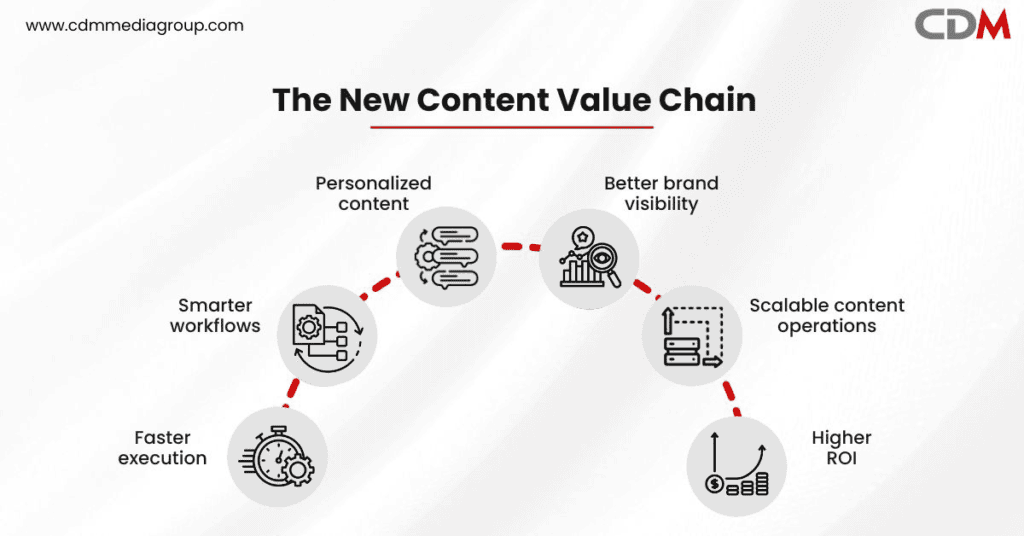
The new content value chain is a strategic, technology-driven framework changing content from a cost center to a profit driver. It integrates AI and automated workflows to plan, create, manage, and measure content, maximizing customer engagement, speed, and ROI. Key components include AI adoption, personalized experiences, and cross-platform content distribution, supported by an AI content strategy.
What is the content value chain?
The content value chain includes the following steps: planning and creating content; reviewing and approving content; localizing, amplifying, and reusing content; publishing content; measuring, iterating on, and optimizing content. A content value chain shapes the value of content across different steps of content operations. This shift in perspective, especially for large organizations, helps keep the focus on the business imperative to improve the quality, velocity, and availability of your content.
As demand for digital content increases, brands can respond to the moment by using the right tools and prioritizing content quality, efficiency, and trust as the foundation of their AI content strategy.
From Manufacturing to Content: Building brand authority with AI
A content supply chain (also known as the content value chain) applies fundamental principles of supply chain management to content creation and distribution.
Let’s explore this analogy further:
- Raw Materials: In manufacturing, raw materials might be steel, plastic, or textiles. In content creation, the raw materials are ideas, data, research findings, and creative concepts. These are the building blocks for creating and delivering content to build brand authority with AI.
- Processing and Assembly: A manufacturing supply chain processes raw materials into components, then assembles these into finished products. Similarly, an AI-powered content marketing process takes raw ideas and information and shapes them into drafts, designs, or initial content pieces. These are then assembled into cohesive content assets that combine text, images, and video.
- Quality Control: In manufacturing, products are inspected to ensure they meet specifications. In a content value chain, this means reviewing and editing content to ensure accuracy, consistency in style, and alignment with the brand. Both processes aim to deliver a high-quality end product.
- Packaging and Distribution: Manufactured goods are packaged and distributed to retailers or end consumers. In the content world, this equates to formatting content for various platforms and channels, then publishing and promoting it to reach the target audience.
- Feedback and Improvement: Manufacturing supply chains often include mechanisms for collecting customer feedback to improve products. Similarly, a content supply chain incorporates analytics and audience feedback to refine future content strategies and improve content quality over time.
Why Content Value Chains are Evolving with AI
Enterprises are increasingly focusing on the content value chain to combine fragmented teams, assets, and technologies. This approach allows for:
- Increased Speed: Faster, consistent, and on-budget production through integrated workflows for AI-powered content marketing.
- Enhanced Personalization: Deliver tailored content that builds brand authority with AI, ensuring brand visibility on Google and meeting high customer expectations.
- Improved Efficiency: Using AI-powered content marketing to reduce the cost of creating and distributing the content value chain.
- Measurable ROI: Companies that fully adopt these content value chains see significantly better returns on their investment than their competitors.
How does the content value chain support the scaling of AI-powered content marketing?
An optimized content supply chain brings together teams, tools, and workflows to streamline content creation and distribution. It eliminates duplication, aligns stakeholders, and ensures faster, more efficient campaign execution.
It helps businesses scale high-quality content by:
- Improving speed and agility, enabling quick responses to trends and real-time campaign adjustments for brand visibility.
- Ensuring consistency across all channels to build brand authority with AI search.
- Reducing costs and increasing efficiency by minimizing redundant work on content.
- Providing data-driven insights to refine strategies and boost the ROI for brand authority and visibility on AI platforms.
- Supporting scalability for new structured content and brand expansion.
- Enhancing customer experience, leading to stronger brand authority, engagement, and loyalty.
Overall, the content supply chain transforms content operations into a strategic driver of growth, helping brands deliver relevant, high-quality content at scale.
Why is an AI content strategy important for brands?
An AI content strategy is essential for brands to boost efficiency, enhance personalization, and maintain competitiveness by automating routine tasks and using data-driven insights. It allows faster content production, improved SEO, and consistent brand messaging across channels, freeing human teams to focus on higher-level creativity.
Key benefits of a robust AI content strategy include:
- Increased Efficiency & Speed: AI helps avoid time-consuming tasks such as drafting, editing, and content generation, significantly accelerating production timelines.
- Data-Driven Personalization: AI analyzes user data to create highly personalized, relevant content that improves engagement and customer experience.
- Improved SEO & Content Performance: AI helps identify keyword opportunities, analyze competitor content, and predict which topics will perform best, ensuring content is optimized for visibility.
- Consistency at Scale: For brands managing high volumes of content, AI confirms consistent tone and quality across all platforms.
- Strategic Insights & Forecasting: AI tools can identify content gaps and emerging trends months in advance, allowing AI-powered content marketing to plan more effectively.

Final Thought
The content value chain has evolved into a critical major system for modern enterprises, especially in AI-powered content marketing. By transforming content from a fragmented, manual process into a streamlined, technology-enabled system, businesses can unlock greater efficiency, scalability, and impact.
An optimized content value chain not only aligns teams, tools, and workflows but also confirms that content is consistently high-quality, personalized, and data-driven. This change allows brands to move beyond simply producing more content to delivering meaningful, relevant experiences that build trust and authority.
Moreover, integrating AI into the content lifecycle enhances speed, reduces costs, and provides actionable insights that continuously improve performance. With the right partner, navigating this complexity becomes a source of value rather than confusion. CDM is that partner. We help businesses gain a competitive advantage from a strong content value chain through a cohesive content strategy tailored to them.