
Think about the last time you considered buying a B2B...
Read More




You Don’t Know You are Scaling Until the Questions Change
A founder asks, ‘Can we do it?’ A scaling company...
Read More

Schema Markup for SEO: Essential Structured Data Every B2B Website Needs
According to the July 2026 Schema.org usage dataset, 5,545 Schema.org...
Read More
How a Sportsman’s Mindset Shapes Business Growth
What can building a business learn from building an athlete?...
Read More
How to Build a LinkedIn Marketing Strategy That Generates High-Quality B2B Leads
A strong LinkedIn marketing strategy is necessary if you want...
Read More
The Ultimate List of AI Search Optimization Tools for 2026
Your brand’s reputation is now stored in a new algorithm...
Read More
The Shop Floor Does Not Build Buyer Preference
A manufacturing company can have excellent products, strong engineering capabilities,...
Read More
Topical Authority in 2026: Creating Content AI Models Trust
Over 96.55% of all pages in our index receive zero...
Read More
Winning in AI Search: How to Measure and Expand Your Visibility
The evolution of search is here. Users are shifting away...
Read More
How Retrieval-Augmented Generation Helps AI Search Engines Discover Content
To understand the latest advancements in generative AI, imagine a...
Read More
AI content optimization handles the first 50–70% of drafting, brainstorming, or outlining content, while the user adds the critical final 30% through editing, prompt engineering, and queries. Many organizations are rushing to adopt structured content formats without realizing their content was never designed to be read, interpreted, or reused by AI-driven search engines for content optimization. When information is scattered, inconsistent, or outdated, AI systems are more likely to avoid the issue, surface partial answers, or reinforce confusion rather than clarity.
Content optimization for AI search within a knowledge management (KM) platform is more than a technical exercise; it’s a discipline. It means intentionally structuring and governing information so AI can interpret, reuse, and expand upon it with precision and context. The result is a smarter, more trustworthy internal AI ecosystem that accelerates knowledge discovery, decision-making, and innovation.
When content is optimized for AI summaries, teams see faster, more accurate answers, stronger trust in AI-assisted workflows, and better performance across both search and conversational interfaces. Read on to learn what content formats work best for AI summaries that can systematically deliver the clear, consistent, and high-impact experiences your audiences expect.
Why Big Content Fails in AI Search
Long-form content was built for a different era, one where readers scrolled linearly, and search engines ranked pages holistically. AI search systems work differently from content optimization for AI searches. They break queries into semantic units and match them against indexed content at the high level, rather than the page level.
A 2,500-word pillar post on “email marketing” might be authoritative and well-researched for AI content optimization. Still, if the specific answer to “what’s the best time to send a cold email” is buried in paragraphs, an AI system may never surface it for content optimization for AI search. The signal-to-noise ratio is too high. The unit of value is too large to retrieve cleanly. Microcontent solves these issues by making each idea self-contained, queryable, and context-complete with structured content formats.
Understanding Structured Content Formats: High-Retrieval Microcontent Architecture
High-retrieval microcontent follows a consistent pattern:
Step 1: Content Ingestion: AI systems crawl or access your content, converting web pages, PDFs, documents, and other formats into processable text.
Step 2: Chunking: The full content is divided into smaller segments, typically 200-1,000 tokens (roughly 150-750 words). Each chunk becomes an independent unit in the retrieval system.
Step 3: Embedding Generation: Each chunk is converted into a vector embedding, a mathematical representation that captures semantic meaning. These embeddings enable semantic search beyond keyword matching.
Step 4: Index Storage: Chunks and their embeddings are stored in vector databases, along with metadata (source URL, publication date, author, and section hierarchy).
Step 5: Query Processing: When users query the system, their queries are converted into query embeddings using the same model.
Step 6: Similarity Search: The system searches the vector database for chunks with embeddings that are most similar to the query embedding, typically retrieving 3–20 of the most relevant chunks.
Step 7: Context Assembly: Retrieved chunks are assembled into the context provided to the language model, along with the user’s query.
Step 8: Answer Generation: The LLM generates an answer using both its trained knowledge and the retrieved context, ideally citing specific sources.
Top 8 Recommendations for Content optimization for AI search
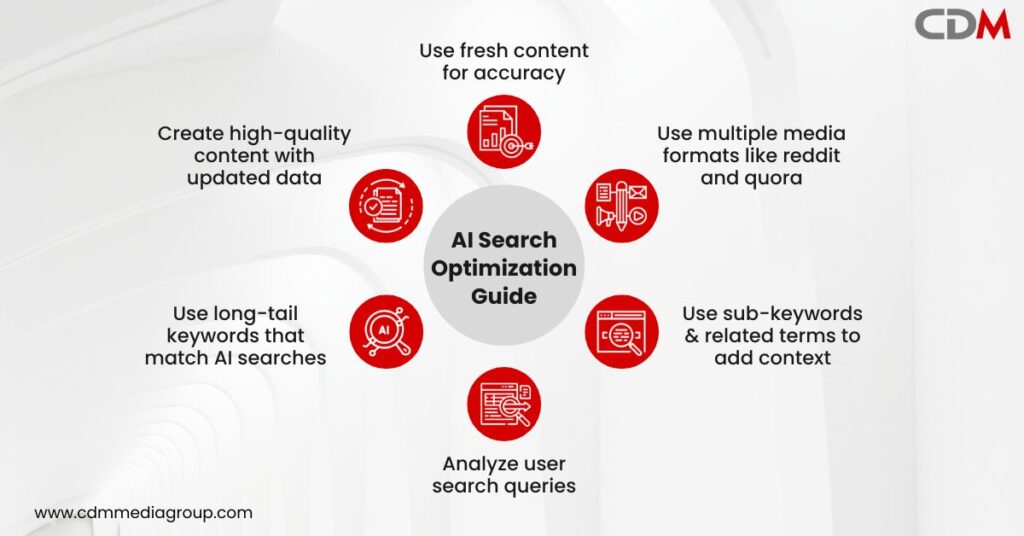
- Keep Content Fresh: Regularly audit and update existing content to ensure accuracy and relevance, keeping your information current and trustworthy with structured content formats.
- Leverage Diverse Media Formats: Create and distribute content in multiple formats (e.g., videos, infographics, social media posts) to increase engagement and enhance content optimization for AI searches.
- Enhance Semantic Search Practices: Improve content relevancy by incorporating sub-keywords and related terms that provide context, helping search algorithms understand the depth of your topics.
- Analyze User Intent: Start by thoroughly analyzing search queries to gain a clear understanding of user intent, which will serve as the foundation for informed content development. Evaluate the attribution paths used by existing users and identify strategic opportunities for improvement tailored to your audience.
- Incorporate Long-Tail Keywords: Conduct thorough research to identify and integrate long-tail keywords that match user intent, thereby improving the relevance of your content to AI search.
- Create High-Quality Content: Focus on producing unique, engaging content that genuinely connects with audiences, using personal anecdotes and specific examples.
- Implement Structured Code: Review and improve website code to ensure it’s easily readable by AI search bots, thereby enhancing visibility and data retrieval efficiency.
- Improve Page Speed: Optimize your website’s load time by enabling caching and compressing images to enhance user experience and retention.
What content formats work best for AI summaries?
If you’re already creating valuable, well-structured content for your site, you’re on the right track. But there are a few technical tweaks that can improve your chances of appearing in AI Overviews:
- Use schema markup: This behind-the-scenes code helps Google understand what your content is about. There are hundreds of schema types (FAQs, recipes, organizations, etc.), and using the right one makes it easier for Google to format your content correctly for AI search optimization.
- Write clear, structured content: Google prefers content that’s easy to extract and summarize. To help:
- Use bullet points for key takeaways.
- Break up text with clear headings.
- Include FAQs and concise summaries.
- Optimize your meta descriptions: Meta descriptions don’t directly impact rankings, but they help Google and users quickly understand what your page is about.
But there’s no guaranteed way to appear in AI Overviews. Technical optimizations can help, but the vast majority of your focus should be on creating content that’s truly worth reading.
The best thing you can do is focus on creating high-quality content that aligns with Google’s E-E-A-T criteria (Experience, Expertise, Authoritativeness, and Trustworthiness) – or YMYL (Your Money or Your Life) principles if your content covers health, finance, or other critical topics.
Google constantly updates its search quality. Evaluator Guidelines to help its human evaluators judge the efficacy of its content optimization for AI search. This means that, ultimately, you should be writing for people – not for AI.

Looking for content that optimizes for AI search?
CDM Media Group offers effective content solutions designed for ambitious B2B brands. From engaging website copy to SEO-driven content and conversion-focused copywriting, we bring together technology and storytelling to deliver results that matter.
Get in touch with us now to kick off your journey!