
You’ve got a Slack workspace with 847 members. Your Discord...
Read More



International SEO Strategy: Common Mistakes SaaS Companies Should Avoid
A market research study projects that the global SEO market...
Read More

How to Create Sales Enablement Content for Every Stage of the B2B Buyer’s Journey
According to Gartner’s 2026 sales survey, 67% of B2B buyers...
Read More
How B2B Podcast Marketing Builds Authority and Drives Pipeline
Podcasting has become an increasingly important channel for brands looking...
Read More
How B2B Video Marketing Improves Brand Trust and Sales Conversions
Think about the last time you considered buying a B2B...
Read More
You Don’t Know You are Scaling Until the Questions Change
A founder asks, ‘Can we do it?’ A scaling company...
Read More
Schema Markup for SEO: Essential Structured Data Every B2B Website Needs
According to the July 2026 Schema.org usage dataset, 5,545 Schema.org...
Read More
How a Sportsman’s Mindset Shapes Business Growth
What can building a business learn from building an athlete?...
Read More
How to Build a LinkedIn Marketing Strategy That Generates High-Quality B2B Leads
A strong LinkedIn marketing strategy is necessary if you want...
Read More
The Ultimate List of AI Search Optimization Tools for 2026
Your brand’s reputation is now stored in a new algorithm...
Read More
Is the content you are writing actually structured in a way that AI Overviews will pick it up and cite it? If your blog isn’t showing up in search results despite having solid content, the problem might not be what you’re writing; it could be how you’re structuring it.
Modern search goes beyond simple page indexing. AI-driven platforms such as Google, Bing, and Perplexity now utilize AI to understand, rank, and summarize web content even before a user navigates to a specific link.
This blog post walks you through how to structure your titles, headings, keywords, lists, tables, schema markup, and metadata so AI systems can fully understand and surface your content, increasing your chances of landing in Google’s featured snippets and AI-powered search previews.
Why structuring blog content matters for AI search
AI tools scan pages like humans, skipping and jumping from header to header.
A clear layout with short sections and well-structured HTML makes it easier for AI to pull out quick answers and display them in search results.
Breaking posts into logical sections helps AI pull precise answers, which improves your chances of showing up in featured snippets or AI results.
Clean tables, short bullets, clear alt text, and Q&A blocks tell both people and search engines that your content is fresh and useful.
How do AI search engines read blog content?
Content structure for AI search engines to figure out your content.
Schema markup gives machines a label that says “this is a how-to” or “this is a product.”
That extra layer helps you get pulled into featured snippets and AI cards.
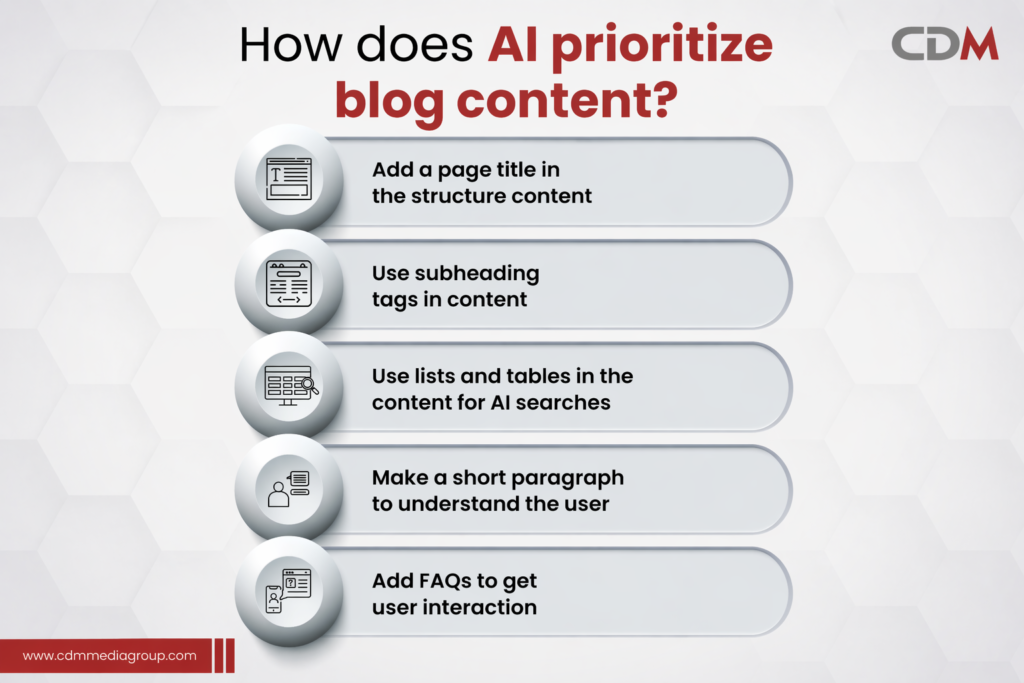
1. Structuring Content for AI Search Engines
- Start with your page title and H1.
- Keep them direct and consistent.
- These show both search engines and readers what the post is about.
- Align your meta description with them for clarity.
- A title like “How to Format a Blog for AI Search” is not just clear; it’s easy for systems to index across web, image, and video search.
2. Use subheadings to guide searches and readers.
- Break your post into sections using H2s and H3s.
- This sets a clear content hierarchy.
- It helps both readers and bots follow the flow.
- Subheadings should match the content they introduce and support E-E-A-T signals (experience, expertise, authoritativeness, and trustworthiness).
- Internal links between sections help AI map your ideas.
- Use keywords where they naturally fit, but don’t force them in.
3. Add Q&A Blocks to Highlight Key Answers
- Question-based headings tell AI what kind of answer is coming.
- A heading like “What is a 301 redirect?” gives search tools something predictable to work with.
- Keep answers short, two or three sentences long.
- Use the FAQPage schema if it applies.
- Add “Quick Answer” or “TL;DR” (too long; didn’t read) summaries for quick takeaways, and update them as needed to align with search trends.
4. Use Lists and Tables to Improve Clarity
- Lists and tables make information easier to scan.
- They work well for features, stats, or tool comparisons.
- AI tools like Google’s AI Overviews and AI search engine content structure often pull from these formats.
- Use them alongside headings and short paragraphs to make your content easier to read.
- This layout helps both people and machines find what they need quickly.
5. Keep Paragraphs Short and Clear
- Stick to two or three sentences per paragraph.
- Use tools like Ahrefs or SEMrush to guide your topic selection with real search terms.
- Schema markup, especially JSON-LD, tells machines whether your content is a guide, an FAQ, or something else.
- Make sure important points are visible. If something is buried in tabs or long blocks of text, AI tools may skip over it.
Focus on unique, valuable content for people.
People often ask how to make content that’s “what Google wants.” We answer that Google wants to show content that fulfills people’s needs. Focus on making unique, non-commodity content that visitors from Search and your own readers will find helpful and satisfying. Then you’re on the right path to success with our AI search experiences, where users ask longer, more specific questions and follow-up questions to dig even deeper. By the way, unique and valuable content is also important for our blue link results as well.
Provide a great experience to optimize blogs for search engines
Even the best content can be disappointing if they arrive at a page that’s cluttered, difficult to navigate, or makes it hard to find the main information they’re seeking. Ensure you’re providing a good page experience for visitors arriving from both classic and AI search results, including whether your page displays well across devices, the latency of your experience, and whether visitors can easily distinguish the main content from other content.
Keep your content reachable
Make sure your pages meet Google Search’s technical requirements so AI can find, crawl, index, and consider them for showing in our results. This includes confirming that Googlebot isn’t blocked, that the page works (Google receives an HTTP 200 status code), and that the page has indexable content. Meeting the technical requirements generally covers the Google overview, including AI formats.
Ensure structured data aligns with the AI search content.
Structured data is useful for sharing information about structured content in a machine-readable format, enabling AI search to optimize results and determine whether pages are eligible for certain search features and growth results.
If you’re using content structure for AI search engines, be sure to follow Google guidelines, such as ensuring that all content in your markup is also visible on your web page, and validate the structured data markup.
Understand the full value of your AI search.
We’ve seen that when people click on a website from search results pages with AI overviews, these clicks are higher quality, and users are more likely to spend more time on the site. Why is this? AI results may provide people with more context about a topic overall and display more relevant supporting links than classic search engines.
This may attract a more engaged audience and create new opportunities for visitors, but you might not optimize for them if you focus too much on clicks rather than the overall value of search visits.

Evolve with your AI crawl
The only thing predictable about Search is that it always evolves, because people’s needs do too. The classic “ten blue links” format was updated to better serve those seeking visual, video, news, and other types of content.
Desktop displays evolved to mobile-friendly ones. Search evolved to handle voice queries, or “multimodal” queries, such as taking a picture of a flower and having Search identify it from the photos.
AI experiences represent yet another evolution in the structure of AI search engine content, helping us continue to meet users’ evolving needs. This evolution also means new opportunities for site owners.
Are you ready to implement this?
AI is transforming search quickly. But at the end of the day, Google’s goals remain the same: provide high-quality content to human readers. If this has been your goal too, then optimizing blogs for answer engines should be natural; it’s not easy.
Whether you are creating a new blog or rebuilding an existing one, they know how to make your content matter in a way that reaches both people and AI search.
Let’s connect to rethink how your content performs in today’s AI-driven landscape.