If you notice, the whole internet search process has been...
Read More
Mastering Social Media Content Writing for B2Bs: Cross-Platform Strategies for 2025
Social networking and content writing have expanded beyond the B2C...
Read More
CDM Media Group – Content as a Service Provider



If you notice, the whole internet search process has been...
Read More

You know that feeling when everything you thought you knew...
Read More
Sam Altman’s internal memo marked ‘code red’ wasn’t about a...
Read More
For nearly three decades, Search Engine Optimization (SEO) has shaped...
Read More
If you have ever felt like Google Ads is that...
Read More
The Rise of Video in Business Communication There has been...
Read More
Social networking and content writing have expanded beyond the B2C...
Read More
With 60% of marketers citing consistency as their biggest content...
Read More
July 10, 2025 wasn’t just another day in the digital...
Read More
Content alone is no longer sufficient in today’s digitally-driven world...
Read More
You know that feeling when everything you thought you knew about something suddenly becomes obsolete? Yeah, that’s happening right now with content marketing.
For the longest time, we all lived by one rule: pack your articles with the right keywords and you’ll rank. Some of us even got a little ridiculous with it, stuffing phrases where they didn’t belong, contorting our writing to hit some magic keyword percentage. It felt clunky, and honestly, our readers could tell something was off.
But here’s the thing that just happened: AI got good. Really good. And now all that keyword stuffing feels like trying to impress someone with a broken GPS.
Search has evolved. While matching words is no longer sufficient for a successful search, today’s search systems use all of the tools at their disposal to find relevant pages (i.e., not just matching words, but also understanding context and nuance). Search systems can now see that search queries such as “legal assistance in Denver that is affordable,” and “lawyer in my area who is inexpensive,” are the same thing.
This is a fundamental shift in how content needs to work. Instead of thinking about keywords, start thinking about knowledge. What do you actually know? What questions does your audience have? How can you organize your information so that both people and AI systems can easily understand and use it?
The good news? This pushes us back toward better writing anyway. You are no longer fighting against the system trying to write naturally while hitting keyword targets. You can just write actual helpful content.
Here’s what trips people up: they think they need some special new technique. But honestly, it mostly comes down to basic organization.
When writing about a subject, consider how you would explain it if you were in front of a person. Most likely you would have a primary point that you broke up into smaller parts, and that’s your basic outline and the structure of your content. When using headings you should be following the intended use for those heading levels – the main heading is your H1, next are the larger sections; your H2s, then the pieces within each larger section are your H3s. This creates a logical ‘map’ of what you cover so both readers and AI can follow it.
When writing on Digital Marketing, ensure that you clearly define what Digital Marketing encompasses using: Content Marketing, SEO, Social Media, Email Marketing, and Paid Advertising. Subsequently, anyone (whether Human or Algorithm) will have a better understanding of what you mean and also where to find more information about each subject separately.
This sounds more complicated than it is. There is something called structured data markup (Schema.org if you want to look it up). It’s basically a way of tagging your information so AI systems know exactly what they are looking at.
Imagine explaining a recipe to someone versus feeding it to a recipe app. The app needs to know: this is the title, these are the ingredients with quantities, this is the prep time, these are the steps. Markup does that for your content. It tells AI systems, “This is an article, it was published on this date, the author is this person, the main topic is this.”
You can use it for Q&As, reviews, products, events, business information, basically anything. When you do, you are making it dead simple for AI systems to pull your information and show it to people who need it. You are not hoping they find you. You are basically putting your hand up and saying, “Here’s the answer you are looking for.”
People don’t search in fancy prose. They search in questions. “How do I…?” “What’s the best…?” “Why would I?”
So write like that. If you are going to include a FAQ section, make it real. Answer the actual questions your audience has. Better yet, structure your whole piece around answering those questions directly. Make the answers obvious and easy to spot.
Here’s why this matters: people scanning your site get what they need fast, and AI systems looking for answers find them easily. Everyone’s happy.
Think about how you actually understand topics. You connect them. You know that content marketing relates to audience building, which relates to brand loyalty. AI systems work similarly, but through links.
When you are writing about one topic, link to related stuff you’ve written. If you are talking about measuring marketing success, link to your pieces about ROI or data analysis. These connections show AI that you understand your field deeply. They also help people discover more of your helpful content.
AI systems are getting better at spotting who actually knows what they are talking about. They look for what Google calls E-E-A-T: Experience, Expertise, Authoriousness, and Trustworthiness.
Make this obvious in your content. Who wrote this? What are their qualifications? When was this published? Has it been updated? Where are you getting your information? Include real case studies, actual testimonials, proof that this stuff works. Link to credible sources. Make it clear you are not just guessing, you are drawing from real experience and knowledge.
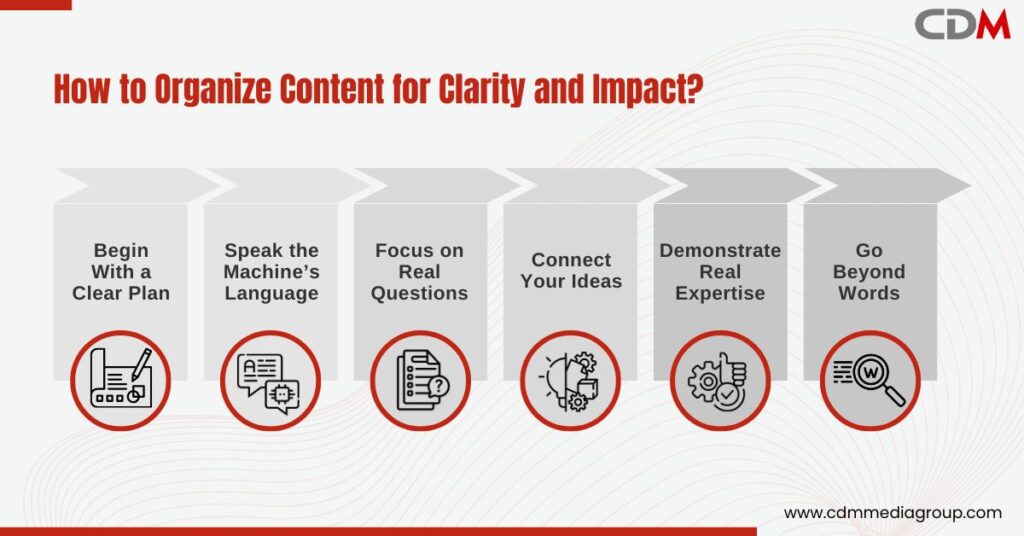
Your audience isn’t just reading anymore, they are engaging with videos, images, infographics, and charts. And AI systems can understand all of this stuff now. Include multimedia when it makes sense. Add descriptions to images. Transcribe videos. Make sure people with screen readers can understand your content. Better content for everyone, and better for AI systems too.
The world is moving away from tricking algorithms and toward building actual knowledge. The content that wins is the stuff that’s genuinely useful, clearly organized, and honest about what it covers. It’s the content that serves both the person reading it and the AI systems trying to surface good information.
Stop thinking about gaming the system. Start thinking about being the best source for what you know. That’s what lasts.

Shifting your entire content operation is real work. It’s not a quick fix. It’s a rethinking of how you organize, structure, and present information.
If you are feeling like this is the direction things are headed and you want to make the move, but you are not entirely sure how to pull it off, that’s where CDM Media Group comes in. They work with brands to restructure their content, set up the technical foundation, and build a real strategy for this new world.
Whether you are starting fresh or rebuilding what you’ve already got, they know how to make your content matter in a way that reaches both people and AI.
Let’s connect to rethink how your content performs in today’s AI-driven landscape.